General’s Shoulder Boards
Army (Heer), Administrative, Special
Careers
|
Please note: The information
shared here is merely opinion-based criteria resulting from decades of study
as an enthusiast and collector of this genre. It is not definitive, nor offered as
“expert” opinion.
There is still much we do not know and may never know about the
manufacture and variants produced during WWII, and without surviving
documentation, speculation will always be a part of this hobby for some material. I present this merely as a guide based
on examples and information that I am comfortable with and use in my own
collecting criteria. |
Please note: The information
shared here is merely opinion-based criteria resulting from decades of study as
an enthusiast and collector of this genre.
It is not definitive, nor offered as “expert” opinion. There is still much we do not know and
may never know about the manufacture and variants produced during WWII, and
without surviving documentation, speculation will always be a part of this
hobby for some material. I present
this merely as a guide based on examples and information that I am comfortable
with and use in my own collecting criteria.
General’s shoulder boards are seen in a wide array of
differing construction in regards to size, materials used, and design
techniques. Typically they were
constructed of two, gold colored cords surrounding an inner silver colored
cord. The cords formed four bends
on each side plus a loop at the top for the button. There do, however, exist genuine WW2
specimens which have five bends (unfortunately for collectors, post war
|
|
|
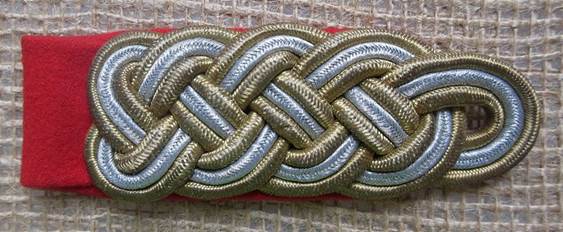
A mint condition example of a shoulderboard
in gold bullion and silver cord.
This is what is referred to as a “sew-in” board and he red
cloth extension was placed into the opening in the shoulder and then sewn
shut. A button was then put
through the open loop at the top securing it to the shoulder area. |
|
|
|
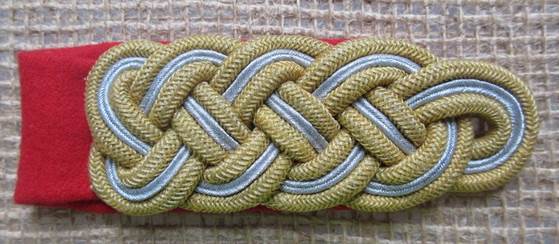
A mint condition example of a shoulderboard
in gold celleon (nylon) and aluminum cord. |
|
|
|
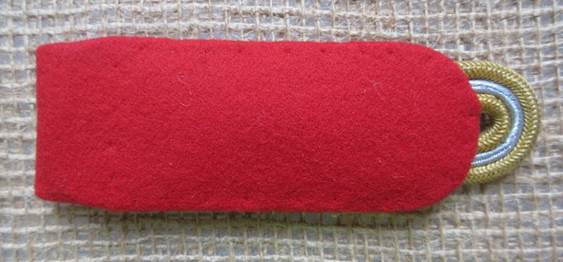
The reverse of a shoulderboard. Notice the tiny stitch holes around the
outside edge and bottom base of the board which indicate where the cords were
sewn down on to the cardboard underlay backing. The red cloth extension was placed
into the opening in the shoulder and then sewn shut. |
|
|
|
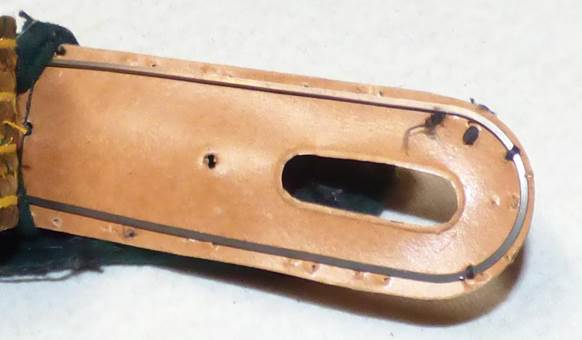
Here’s a good look at the cardboard underlay backing
and the wire stiffener (this example is from a junior officers shoulderboard).
You can see the tiny stitch holes that go through the cardboard and
you can also see the positioning of the wire stiffener around the
circumference of the board (as well as a couple of stitches holding it in
place). |
|
|
|
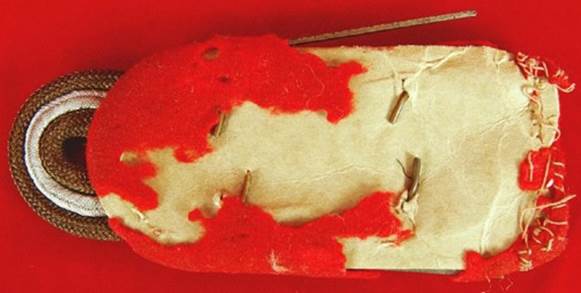
Here’s an example of the back of a General’s
board that has suffered severe moth damage, revealing the cardboard underlay
and the wire stiffener which has come loose. |
|
|
||
|
An example of a high quality brite bullion cord shoulderboard, typically used for parade or more formal
walking out or service dress uniforms. (Ron Richter collection) |
||
|
|
||
|
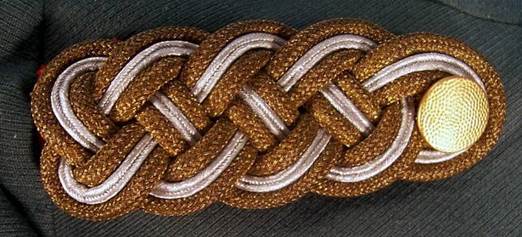
A subdued matte
bullion example. Matte bullion
was typically used for field dress, though not always. By now the gold bullion has aged to a
dark, matte brown color. This
example has a non-visible red underlay, which indicates that it is an early
pre-war example. (Ron Richter collection) |
||
|
|
||
|
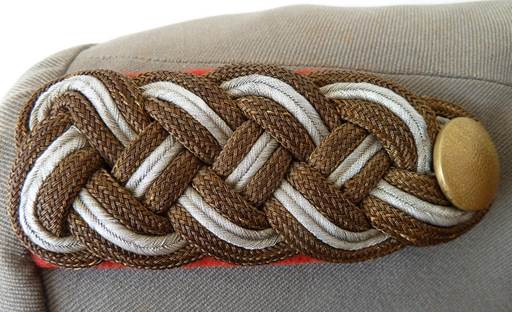
Another matte bullion example on a lightweight field
tunic. |
||
|
|
||
|
A brite bullion example, which
shows darkening of the bullion from age.
The difference between brite bullion and
matte bullion, is that the brite bullion cord has a
‘shiny’ or reflective appearance to it, even with the darkening
of the bullion due to age. (Wolfe-Hardin collection) |
||
|
|
||
|
Another example of brite
bullion gold cords. Notice the wider
braiding of the cords, leaving open gaps in between. |
||
|
|
||
|
A mint condition example of brite
bullion gold cords which is part of the high ranks tailor-shop horde
discovered in 2016. |
||
|
|
||
|
A similar example to the one above, this from a surviving
tunic. |
||
|
|
||
|
The other material that Generals shoulderboards
was constructed from was celleon, which is a nylon like material and was
substituted for the gold cords.
It was also produced in both a matte and brite
finish. This example, from the
uniform of General Friedrich Fangohr, is matte celleon. |
||
|
|
||
|
An example of a matte celleon board
on a black panzer wrapper. |
||
|
|
||
|
An example of gold bullion outer cords and silver aluminum
inner soutache cord, from the tropical uniform of Generalmajor
Heinrich-Hermann von Hülsen. Notice the wider spacing between the braided
cords. This is often seen as a red-flag by some collectors, but it is only indicative of a
variation in manufacture. Some of
Rommel’s Generalfeldmarschall boards also
have wide gaps in the braiding.
Both this von Hülsen uniform and the Rommel boards have solid
provenance, proving that not everything was done to modern collector “textbook”
expectations. There was indeed variation,
and we see it in the original material that is unquestionable. |
||
|
|
||
|
An example of matte gold bullion outer cords and silver
aluminum inner soutache cord, from the tropical uniform of Generalmajor Walter
Stettner. |
||
|
|
||
|
An example of matte gold bullion outer cords and silver
aluminum inner soutache cord, from the parade dress uniform (Waffenrock) of Generalmajor
Erwin Rommel. |
||
|
|
||
|
A Generalleutnant example, in matte celleon,
this one from a field uniform. This one also has the large, General’s
size pip. (Ron Richter collection) |
||
|
|
||
|
Generalleutnant
board in brite celleon
with a single, large silver pip.
General officer boards typically (but not always) have a larger size
“General’s” pip, which can range in size from 28mm to
38mm. Standard officer size pips
were also commonly used. (private collection) |
||
|
|
||
|
Matte bullion gold cords with a single, large Generals
rank pip that has a silver wash.
|
||
|
|
||
|
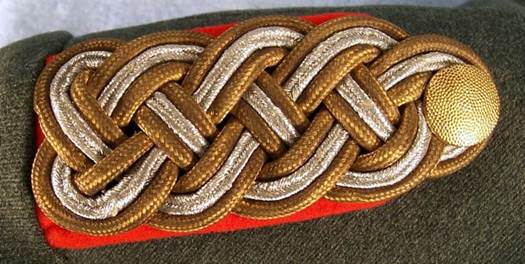
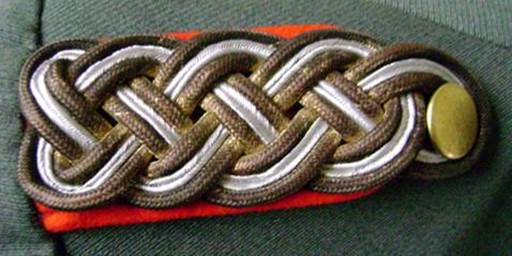
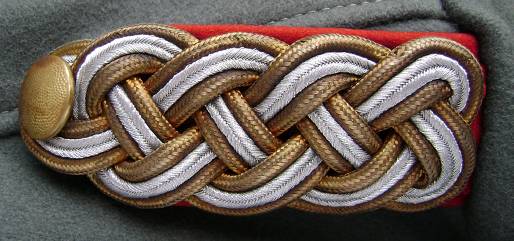
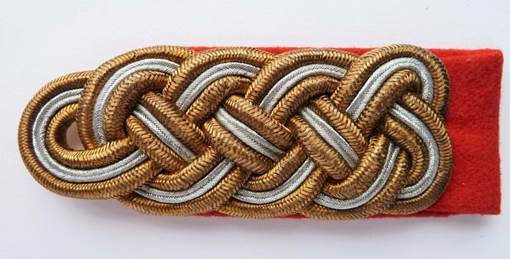
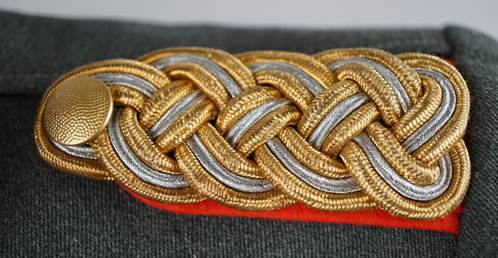
Matte bullion cords with the large oversized pips designed
specifically for General officers. |
||
|
|
||
|
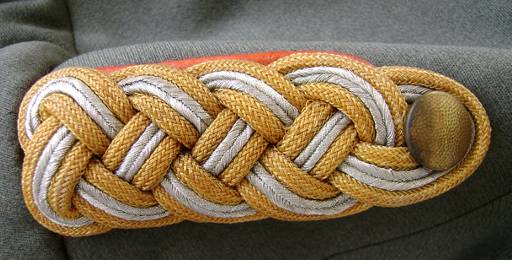
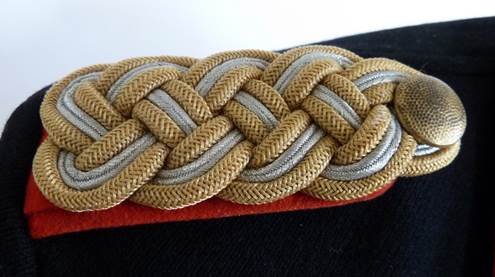
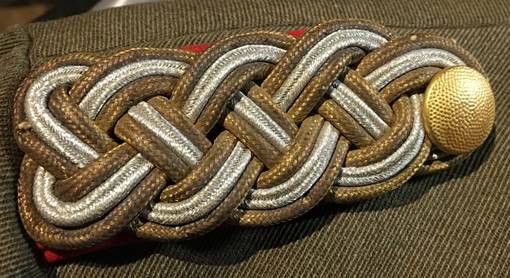
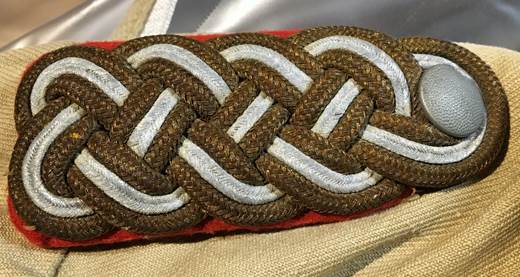
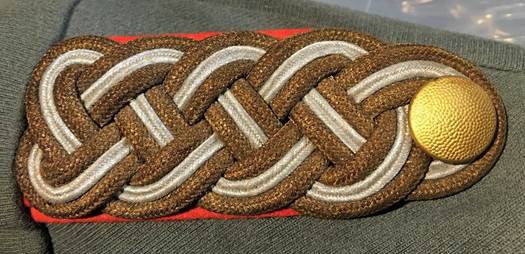
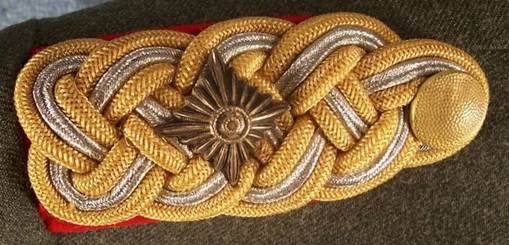
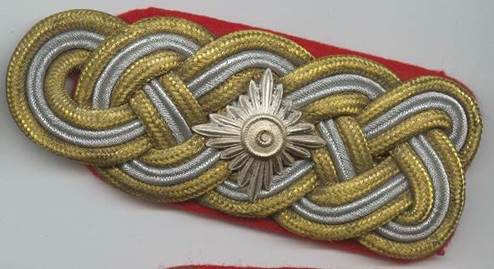
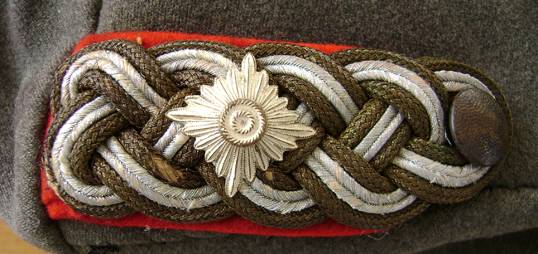
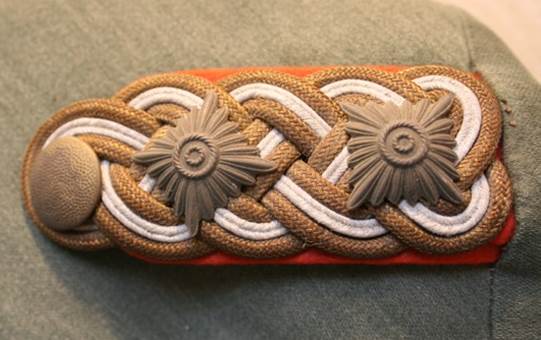
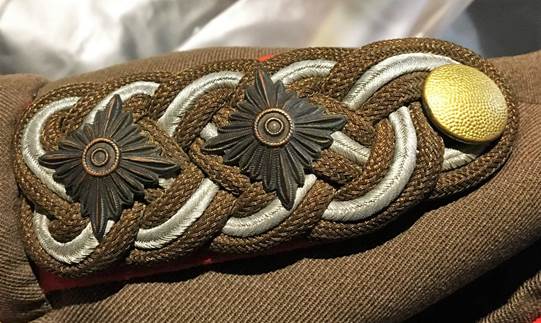
Matte bullion cords with the large oversized pips from the
tropical uniform of General der Panzertruppe Georg
Stumme. |
|
|
|
General der Infantarie Waldemar
Erfurth shoulderboard, matte bullion with
silver-aluminum inner soutache cord and two, large
silver finish pips. Most of the
silver finish has worn off the pips exposing the brass metal. This is a very common occurrence with some of the Generals pips. (Private collection) |
|
|
|
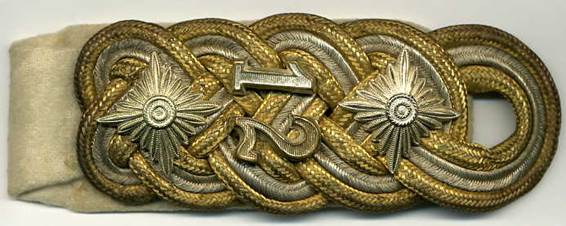
General der Infanterie board
"with the Uniform of Infantry Regiment 12" as worn from 30
September 1931 to 30 June 1942 by Pour le Merite/German
Cross in Silver recipient Rudolf Schniewindt
(1875-1954). Note the white
underlay to indicate the honorary appointment to an infantry regiment and the
“12” cipher indicating the regiment number. Selected General’s were bestowed
with the right to wear the uniform of their traditional regiment and was
considered a high honor. In
addition to wearing the underlay of their branch of service and regimental
cipher, they also wore the collar tabs of an Oberst and a field grade
officers breast eagle. (Richard Lundstrom collection) |

|
|
|
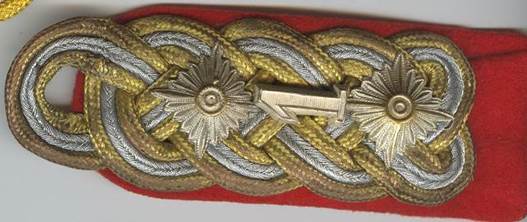
A full General’s board with a numerical
“1” device indicating that the former owner likely held the
honorary title of General with the Uniform of a Regiment. (private collection) |

|
|
|
General der Infanterie shoulderboard of brite bullion
cord, again showing the oversize General officer rank pips. Notice how the edges of the pips
extend so far across the width of the shoulderboard
in comparison to the other examples shown on this page. (private collection) |
|
|
|
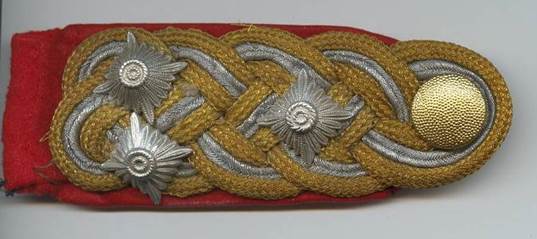
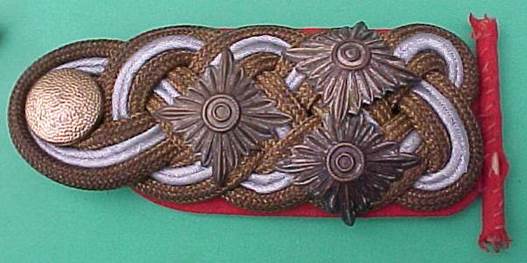
General der Infanterie board
from the uniform of Kuno-Hans von Both, a well decorated Russian front
veteran and Pour le Merite and Knights Cross
recipient. Matte gold bullion example. (private collection) |
|
|
|
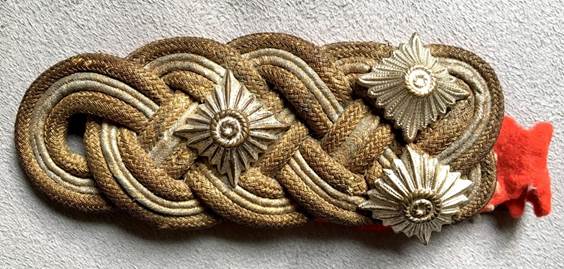
Generaloberst shoulderboard constructed in celleon
gold cords with aluminum inner braid with three, small matte silver colored
pips. Smaller pips, like these,
were commonly used though sometimes you also see the larger General’s
pips used on Generaloberst boards….which
gives the board a very ‘crowded’ appearance and leaves a major
overhang of pips on the side.
Sometimes you will also see the single pip
placed lower on the board next to the two bottom,
side by side pips. Rarely, you will also see all three
pips centered on the board together.
Generaloberst is one of the rarest ranks to
find! (private collection) |
|
|
|
Generaloberst shoulderboard in matte gold bullion and silver inner
cord. This example is a smaller
board, probably shirt size, with the typical larger Generals pips which as
you can see ‘crowd’ the board in comparison to the above example
utilizing smaller pips. The bar
at the bottom of the board is for attachment to the loops on a shirt or white
summer tunic at the shoulder seam. (Dave Howerdel collection) |

|
|
|
Generaloberst shoulderboard in matte gold bullion and silver inner
cord. This example is from a
surviving, un-named uniform. Note the dark age tone of the pips and
how they extend over the edges of the board, which is quite common when using
the larger size pips reserved for General’s. (Private collection) |

|
|
|
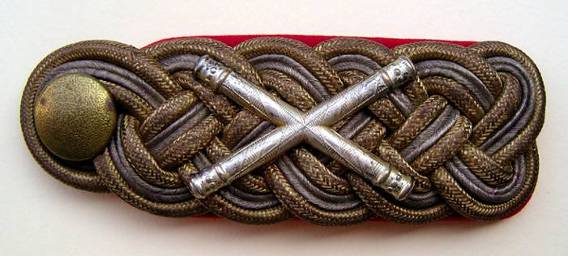
Generaloberst Erwin
Rommel’s shoulderboard in matte gold bullion
and silver inner cord. This
example was removed from one of Rommel’s tunics by American soldiers
who had entered Rommel’s home at the end of the war. Rommel was Generaloberst
from January 30 of 1942 until June 22 of 1942 during the time of his greatest
successes in the Afrika campaign.
Note the mixture of different pips from two
different manufacturers. (Private collection) |
|
|
||
|
Here is a very interesting photo of Generaloberst Erhard Raus. Notice the pip configuration on his shoulderboards for Generaloberst rank; three pips in a row instead of the triangular configuration. We might assume this was done in the field upon learning of a promotion, as it would certainly be easier just to push a new pip in the center between the other two pips. This uniform survived the war and is in an American collection. There is also a surviving uniform of Rommel’s that has three pips in this same configuration, and it has a period photo documenting that one in wear too. These days if a collector were to encounter the pips for Generaloberst rank arranged in a linear fashion like this they would be deemed fake, incorrect or “put together”. Obviously when it came to rank upgrades, these Generals had more to be concerned about in fighting a war than what militaria collectors’ expectations of their insignia placement would be in 75 years!!
|

|
General
Officer Shoulderboard Variants Like most other insignia, Generals shoulderboards
were made by a variety of manufacturers and this is reflected in the many
different types of shoulder boards that collectors encounter. The boards were made in different
sizes, both to accommodate different uniforms items (larger boards for an
overcoat, smaller boards for a shirt or tunic) and to accommodate different
sized humans. The regulation
specified that the shoulder boards be attached to the tunic so that they were
no more than 2cm from the collar edge.
A man with larger shoulders thus would need bigger and longer shoulderboards.
Sometimes, however, you will see a small General with very large shoulderboards, which we must assume was their
preference. General Eduard Dietel
was one who exhibited several odd variants in wear. In the left photo, we see Dietel
wearing an early style (with the non-visible red underlay) pair of very large
shoulderboards, which is odd as this was later in
the war when he held the rank of Generaloberst. In the right photo we see Dietel
earlier in the war wearing the 5-loop variant Generals shoulderboards. By regulation, Generals shoulderboards were supposed to have 4 loops of cord at
the side, excluding the button loop (he is wearing 4-loop boards in the left
photo). |
|
|
|
|
|
|
|
|
An example of a five loop Generals shoulderboard,
this particular example for the rank of Generalfeldmarschall. |
|
|
|
|
|
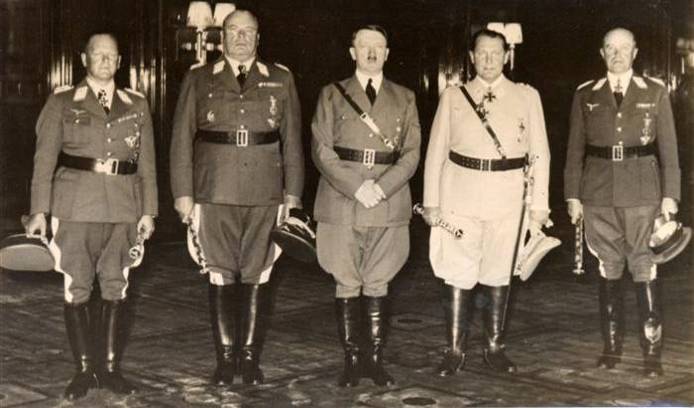
This photo illustrates very well the difference in sizes
of General officer shoulderboards. Each of these
Generals flanking Hitler is wearing a different size of boards. The largest man, Sperrle,
is wearing the smallest boards.
Milch is wearing a very large, fat set of boards (possibly overcoat
size) and Kesselring appears to be wearing a larger, or longer set as well. |
|
|
Additional Heer Generals Shoulderboard Examples, Specialist Careers and
Administrative; |
|
|
|
|
|
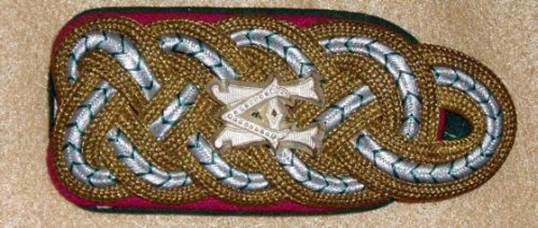
Top: A General officer
in the War/Military Administration Office, designated by a dark green base
underlay with a gray secondary underlay. Bottom: An unusually
constructed set of Generalmajor boards for the Army
in that the inner cord which is typically in aluminum (when celleon is used for the gold cords) appears to be made in
a gray shade of celleon in a basketweave
pattern. These boards were vet
acquired along with a group of other, original General officer militaria, all
un-issued. While not at all
textbook, items like this deserve further study and may have been indicative
of prototypes for later war efforts. (private collection) |
|
|
|
|
|
These boards are for a General officer of the Wehrmachtebeamte (an official who did not possess the
status of a soldier, yet was a member of the Army) for the rank of Generalstabsintendant, or Generalleutnant
equivalent. The base underlay is
a dark green with a secondary underlay of red. (Holzauge) |
|
|
|
|
|
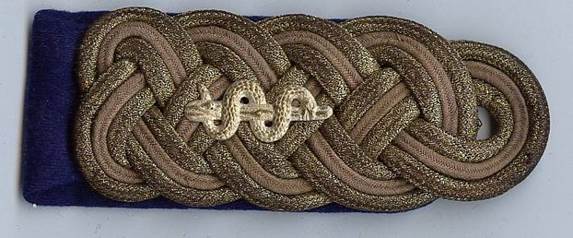
These boards are for a General officer of the Wehrmachtebeamte, who would have been serving on the
staff of the OKW or OKH (High Command) and had the rank of Generalintendant or the equivalent of Generalmajor. The base underlay is a dark green with
a secondary underlay of red. (Holzauge) |
|



|
|
|
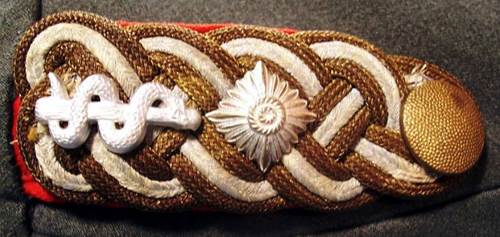
Another Wehrmachtebeamte official
with the rank of General, serving on the staff of the High Command. (courtesy
Thomas Suter collection) |
|
|
|
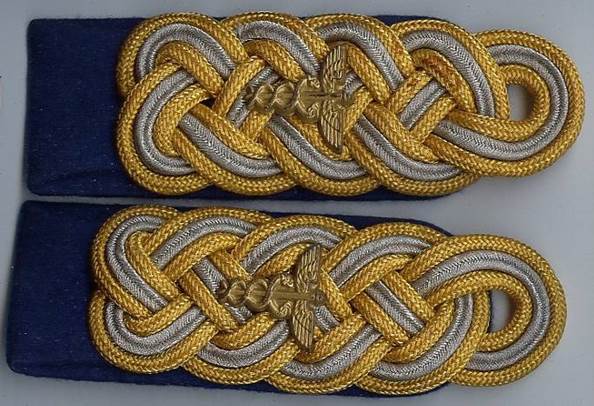
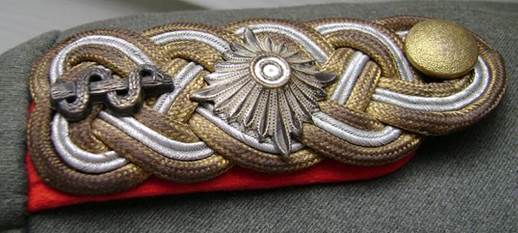
A set of boards for a Generalmajor
in the Administrative Staff (Truppensonderdienst). (Holzauge) |
|
|
|
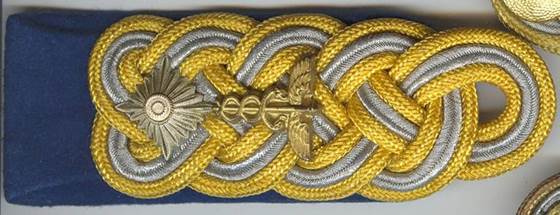
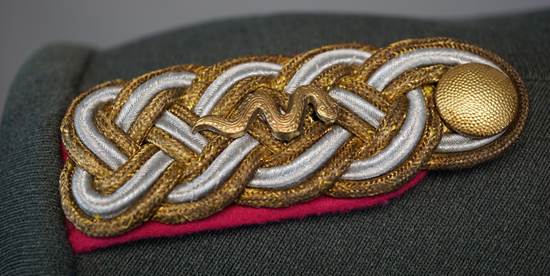
The royal blue backing and Mercurian staff indicate that
this board was for a General in the Administrative Staff, or Truppensonderdienst.
Many collectors confuse the administrative staff and entwining snakes
as being indicative of a medical offers uniform. (the rank of Generalleutnant). |
|
|
|
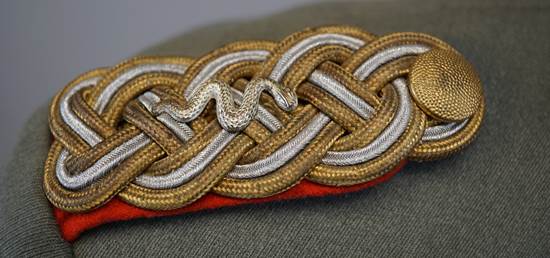
Board for a special career Generalarzt
oin the Medical Services, designated by the
Cornflower blue underlay and Caduceus insignia. Medical officer ranks can be
confusing, as often the doctor was brought into the service at a rank based
on the merit of his education and abilities. During WW1, the medical ranks did not
correspond at all to an equivalent in the army, though it seems an attempt
was made during the second world war. (Holzauge) |
|
|
|
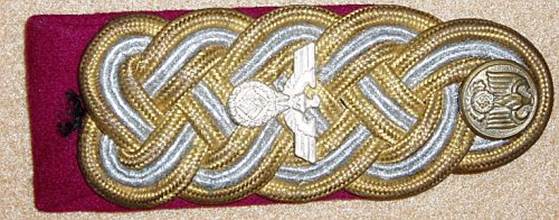
Board for a Heer General officer in the Medical Services,
in aged matte bullion. This rank
is for Generalstabsarzt, or Generalleutnant
equivalent. The bright silver
finish on the caduceus is due to a silver frosting that was applied, which
keeps the silver from turning dark with age. (Ron Richter collection) |
|
|
|
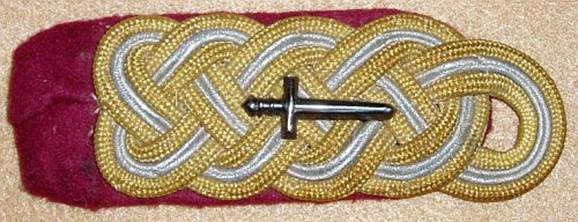
Another nice example of a shoulderboard
for a Heer General officer, or doctor, in the Medical Services, in a bright
bullion cord. Note the difference
in the use of the larger General’s pip, in comparison to the above
photo. (Private collection) |
|
|
|
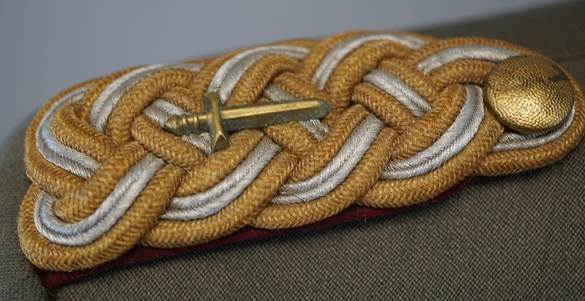
Board for a Generalveterinar.
Gold bullion and silver cord over carmine underlay, which was the branch
color instituted for Career General’s in 1944. (private collection) |
|
|
|
Board for a Generalveterinar.
Gold bullion and silver cord over red underlay, which was utilized prior to
the branch color instituted for Career General’s in 1944. (private collection) |

|
|
|
Board for a Diplomatic Judicial General. Gold bullion and
silver cord over wine red underlay. (courtesy Thomas Suter collection) |

|
|
|
Board for a General in the Judicial Service. Celleon and aluminum
cords over wine red underlay. (courtesy Thomas Suter collection) |

|
|
|
Board for a General in the Judicial Service. Celleon and
aluminum cords over wine red underlay. (private collection) |

Note; I’m always looking for high quality photographs of original
examples of common and unique General officer boards and insignia. Please contact me if you have something
you wish to contribute.
