|
|
The German Army (Heer) Generalfeldmarschall
Insignia GFM von Manstein |
|
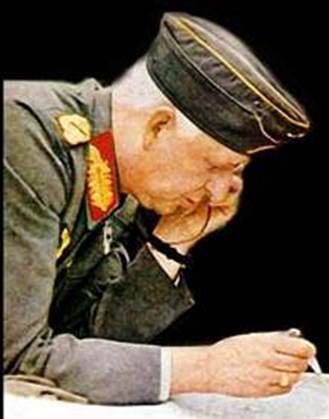
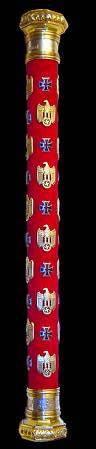
|
Please note: The information
shared here is merely opinion-based criteria resulting from decades of study
as an enthusiast and collector of this genre. It is not definitive, nor offered as
“expert” opinion.
There is still much we do not know and may never know about the
manufacture and variants produced during WWII, and without surviving
documentation, speculation will always be a part of this hobby for some material. I present this merely as a guide based
on examples and information that I am comfortable with and use in my own
collecting criteria. |
Since the
early days of organized warfare there have always been leaders on the
battlefield and in the war room whom have utilized
some form of ultimate authority over the direction of their armies during
wartime. The ranking system evolved
out of the need to direct and manage varying numbers of men and equipment and
as the armies expanded, so did the need for higher authority. In modern warfare, the highest military rank recognized is that of
Field Marshal or its equivalent of General of the Army (Fleet Admiral or Grand
Admiral in the Navy). The German
Army of World War Two arguably created the most fame and notoriety of the
position of Field Marshal as any army throughout time having a total of 19
different men attaining this rank.
As such, the crossed batons insignia of the German Generalfeldmarschall
is symbolic of great military power and might.
Army
GFM Shoulderboards
|
|
|
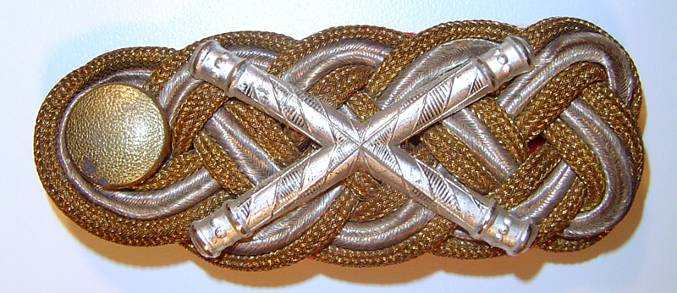
1st
Pattern (1936-39) Generalfeldmarschall
shoulderboards in gold and silver bullion with early
style crossed batons. This particular example is an early Reichsheer
board with a red underlay that is not visible from above. Baton length from end to end is
approximately 58mm. (private collection) |
|
|
|
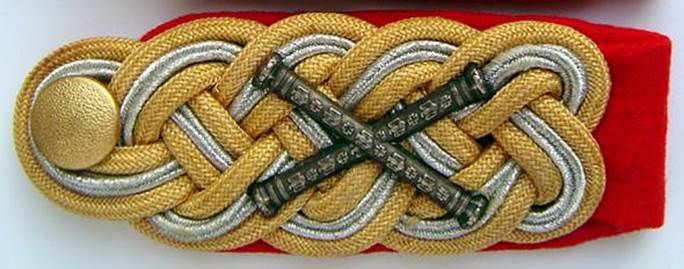
2nd Pattern,
1940 style (Sept. 27, 1940). The first of two changes to what is referred to as the 2nd
pattern of Generalfeldmarschall shoulderboards. This first step altered the design of
the crossed baton devices so that they now resembled the actual Third Reich
GFM Heer batons and were highly detailed. The shoulderboard
remained the basic pattern used for all General officer ranks of gold and
silver cords. This is one of the reasons why GFM’s are commonly seen
wearing the standard pattern General’s boards of intertwined gold and
silver cords as this ‘style’ remained regulation
until April of 1941, though the use continued well after that. This particular example is
manufactured in celleon gold outer cords with an
aluminum inner silver color braid in the soutache design. Baton length, end to end, can vary
slightly as there were multiple dies. (private collection) |
|
|
|
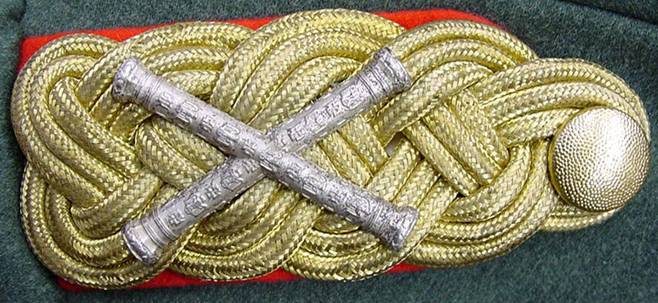
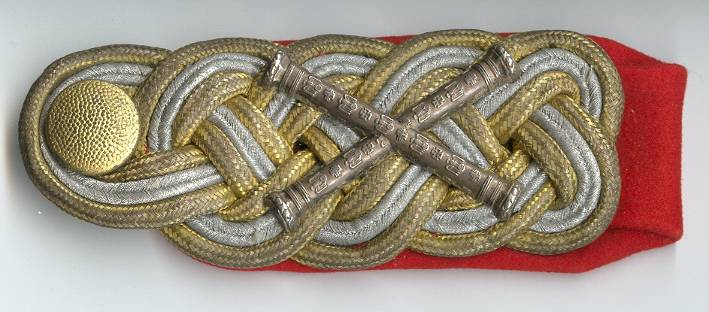
2nd
Pattern 1941 style (April 3, 1941 - 1945). This second pattern incorporated yet another change; the shoulderboard itself was now altered in that the inner
silver cord was now replaced by a gold cord. This beautiful example with all
three cords in bright Gold bullion surmounted by silver, frosted batons is
from the piped service uniform of GFM Fedor von Bock. (Holzauge Historical collection) |
|
|
|
|
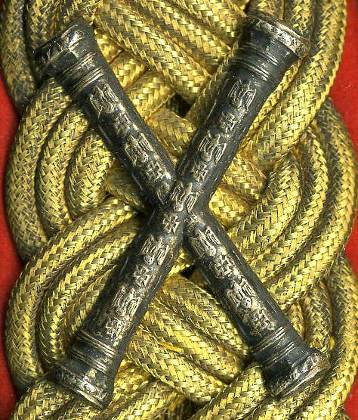
Army style
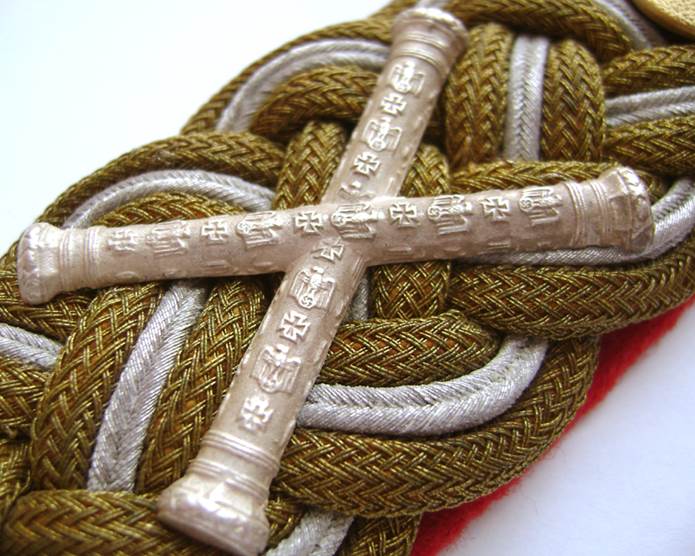
batons Close-up view of the 1940 pattern Generalfeldmarschall
batons for the Army (Heer). The
Army pattern alternates between the iron cross, wehrmacht
eagle and a repeat of the iron cross.
This example is from the uniform of GFM von Manstein and is age
darkened silver. |
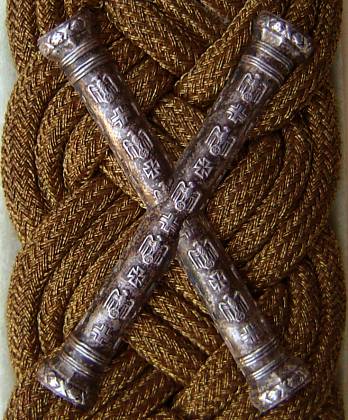
Luftwaffe style
batons Close up view of the Luftwaffe pattern batons, which is
similar to the army except that the pattern alternates between the iron
cross, wehrmacht eagle and a Balkan cross. This example is attributed to GFM
Milch and is stamped in silver and marked “800”. |
|
|
|
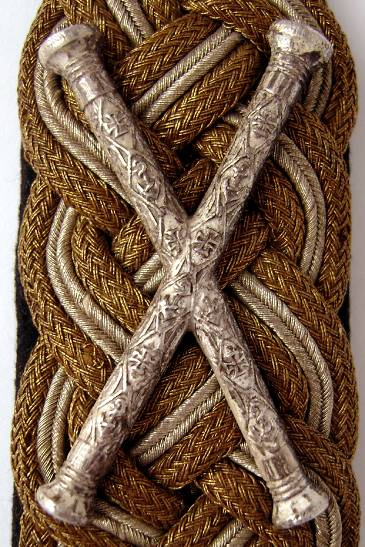
Kriegsmarine
style batons In contrast to the Heer and Luftwaffe pattern are these Kriegsmarine batons for the rank of Grossadmiral. The pattern on these baton devices alternate between iron cross and fouled anchor, with an intertwining anchor chain separating the two for the length of the baton. These are also quite a bit larger than Heer and Luft baton devices. |
|
|
|
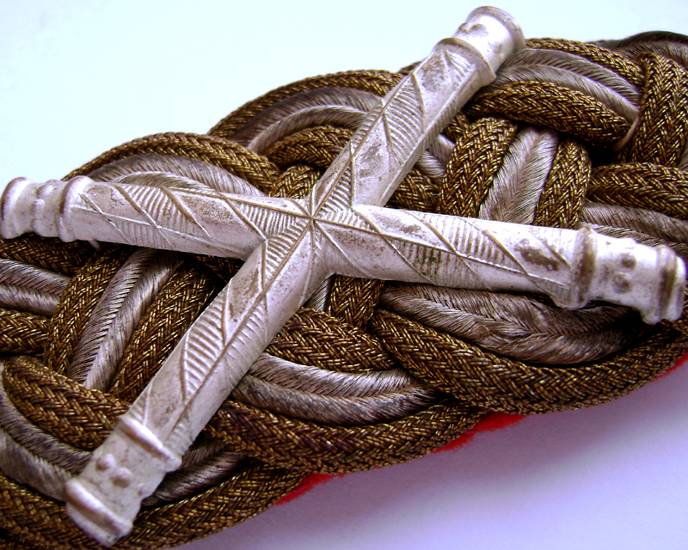
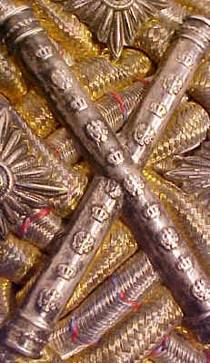
Detail of the 1st pattern, silver frosted GFM batons. |
|
|
|
Detail of the 2nd pattern, silver frosted Heer batons. |
|
|
|
Another example of 1940 style: 2nd pattern Generalfeldmarschall batons on standard pattern
General’s shoulder boards belonging to GFM von Rundstedt. Note that these are Army GFM boards,
yet exhibit the Luftwaffe pattern batons which alternate between the iron
cross, Wehrmacht eagle and balkan cross. This particular specimen was featured
on page 421 in Angolia’s “Uniforms and
Traditions of The German Army 1939 – 1945, Volume I”. It was not uncommon for the Luftwaffe
pattern batons to be used on Army boards. One note of interest; Rommel allegedly
received his first set of shoulderboard batons from
Luftwaffe GFM Kesselring during a visit to his command in Afrika. Kesselring gave Rommel an extra set of
his insignia as Rommel’s promotion had gone into effect while he was in
the desert in Afrika and he had not yet received his new insignia of rank (on
July 23rd, 1942, a month after his promotion, a package would
arrive from Rudolf Schmundt, Hitler’s adjutant, containing the silver
crossed baton devices). More than likely, Rommel’s first boards
reflected this Luftwaffe pattern as a result of the gift from
Kesselring. Stories like this are
a good thing to keep in mind when adhering too closely to the ‘absolutes’
so strongly professed by many collectors. Even Generalfeldmarschall
experienced a variation beyond regulation! On another interesting note, von Rundstedt most famously
preferred wearing his Colonel in Chief of a Regiment uniform which had some
distinct variations to an Army General or Generalfeldmarschall. With this honorary title he was
permitted to wear the insignia of his honorary branch, in his case being his
old infantry regiment 18. This
entitlement found him wearing General’s boards with a white underlay
(for infantry designation) and the “18” number (for his old
regiment) positioned between the batons and the shoulder button. While this seemed to be his preferred
manner of dress, he also wore a wide array of variations and combinations of
boards, underlay colors and batons with or without the regimental number cyphers. Learn more about von Rundstedt at my special page on GFM von Rundstedt. (private collection) |
|
|
|
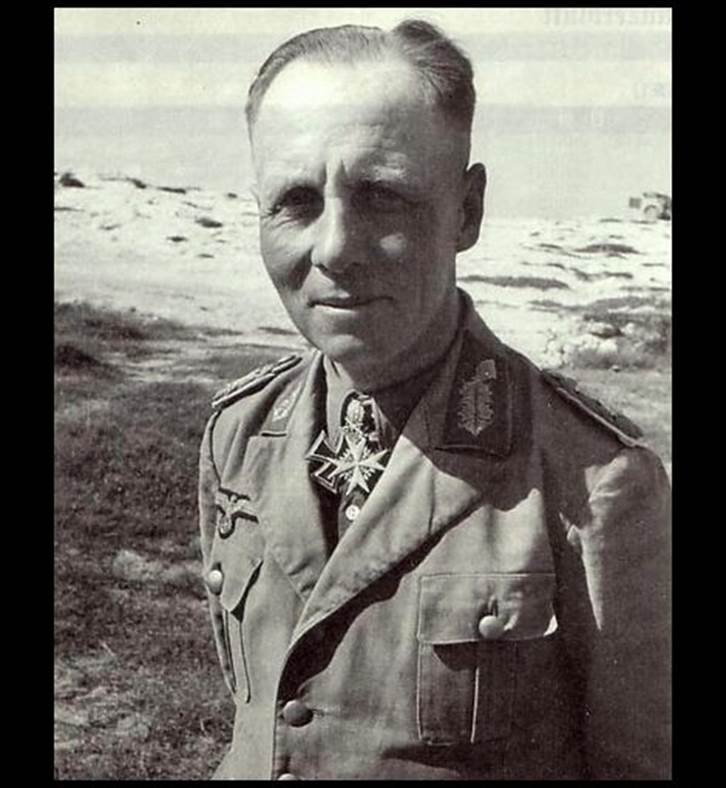
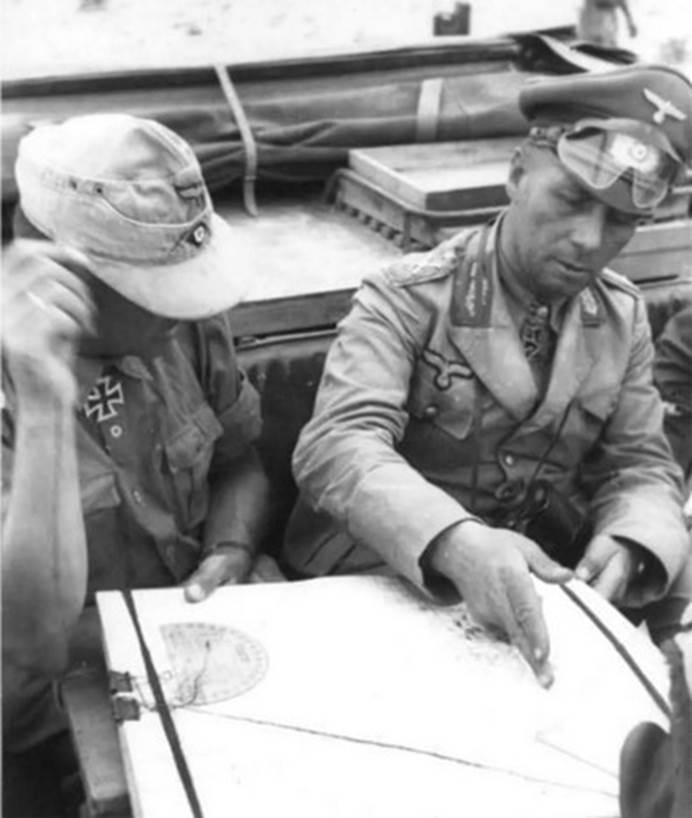
A photo of Rommel in Afrika wearing his tropical
uniform. Notice the shoulderboards.
He is wearing Field Marshal shoulderboards
with a white underlay, which is the color underlay for Luftwaffe Generals.
They appear to be slip-on style boards.
Could these be what Kesselring gave Rommel in the field upon
promotion?! |
|
|
|
A second photo of Rommel, in August of 1942, also wearing
Luftwaffe style Field Marshal shoulderboards with
the white underlay. These appear
to be sew-in style boards, which would indicate the Rommel may have had more
than one pair of these that were white backed. |
|
|
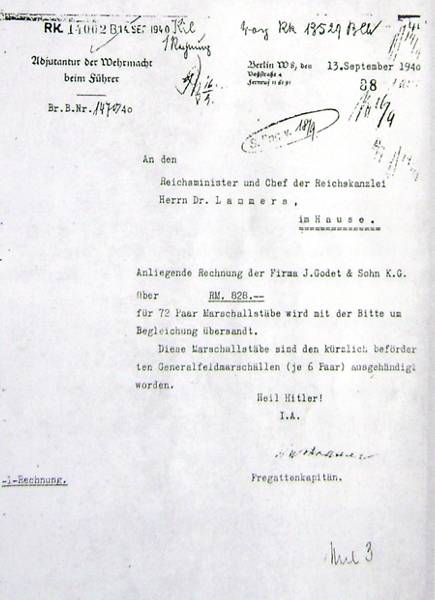
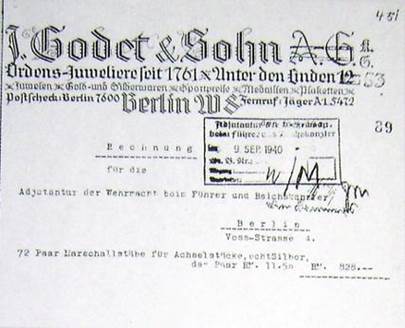
Shown here are September 1940
invoices from the jeweler J. Godet & Sohn for an order of GFM shoulderboard baton devices, made in silver. This order is for 6 pair of devices
for each Field Marshal, likely pertaining to the July 1940 promotion of 12 Generaloberst to the rank of Generalfeldmarschall
(9 Heer and 3 Luftwaffe). We can
assume that this was an initial provision made upon promotion to each GFM,
the six pair likely being to account for wear on the shoulderboards
adorning the Greatcoat, leather overcoat, dress, service and field tunics and
perhaps a shirt. One can also
assume that each GFM likely ordered more devices as needed. There is no indication of an order for
specific pattern, ie; Heer or Luftwaffe. |
|
|
|
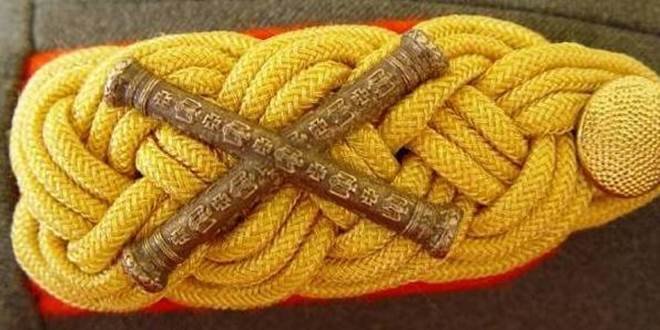
2nd Pattern (1941 style) Generalfeldmarschall
boards with all three gold cords as per the April 1941 regulation
change. This example shows all
three cords in matte celleon. (Courtesy Kai
Winkler collection) |
|
|
|
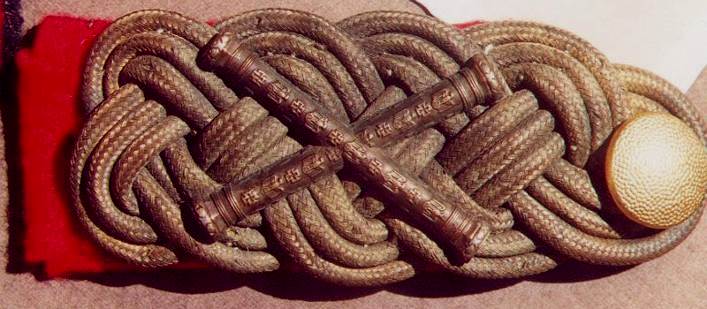
Another example of GFM von Bock boards that have been
removed from a uniform. These
1941 style boards show quite a bit of ageing and dark toning to both the gold
bullion cords and the 800 silver batons. (Holzauge Historical collection) |
|
|
|
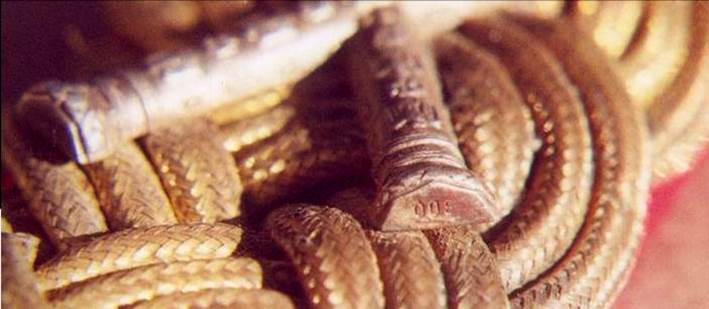
A close up of the silver hallmark of ‘800’
stamped in the end cap of the batons. (Holzauge Historical) |
The “800” Silver Batons
“Collector Myth” UPDATE 1/21/25
There are some in the hobby, both collectors and dealers
alike, who have claimed (falsely so, we now know) that 800 silver markings on
GFM shoulderboards were fake, modern reproductions
(and I can verify that many are indeed repros!). As we can see from the document depicted
above, at least the initial batons delivered by Godet for that first mass
promotion of 19, July,1940 were indeed silver, which according to German law
would require a silver content marking.
One note here; the invoice for silver batons was dated September 13,
1940, two months after the promotion ceremony of July 19, 1940. It is therefore possible that the
initial shoulder insignia these men were given to wear for the July 19 ceremony
were the early, 1st pattern batons, to be later replaced with the 2nd
pattern batons ordered from Godet.
Since the formal Field Marshal batons were already produced and awarded
to these men during the promotion ceremony at the Berlin Opera House, they were
most likely also given shoulder insignia devices as well, which may have
initially been the early 1st pattern. This is of course speculation and until
further evidence surfaces we may never know the answer.
Silver, “800” marked shoulderboard
baton devices are quite rare. I
suspect they were only produced in a small quantity, initially for the July
1940 promotions, with perhaps additional pieces ordered later (as noted below,
Rommel had one pair of boards with batons marked “800”, yet he
wasn’t promoted to field marshal until June of 1942). Most batons I have encountered are not
silver and have been pressed or cast of metal (sometimes in cupal,
as evidence of copper can be seen on some specimens belonging to Manstein) and
sometimes given a silver wash, so they obviously would not be hallmarked as
they were not made of silver. There
are also two different dies used to make the batons
and slight variations in sizes and crispness of detail (Note; the Luftwaffe
produced a version of batons that was much larger). The dies used for the
“800” marked Heer batons are very distinct from the others, though
I have also encountered this same die used with batons that were not
silver. We could refer to this as
the “Godet” die, though that is only theory at this point.
During an early attempt to add some validity one way or the
other to my theory on the silver marked batons, in 2008 I asked the family of
one of the July 19, 1940, promoted Field Marshals to
examine the insignia still in their possession. It was reported that ALL
of the Generalfeldmarschall shoulder boards
that remained with this family had batons that exhibited the “800”
silver markings.
Additionally, in
January of 2025 I had the honor to meet with the family of Generalfeldmarschall
Rommel and personally examine and photograph all the surviving Generalfeldmarschall shoulderboard
and collar insignia, some of which had been removed from his various
uniforms. I can now verify that
Rommel also had a set of shoulderboards with
“800” marked silver batons, featuring the distinct die pattern
associated with these “800” marked pieces. I authored an article in
the magazine International Militaria Collector which explores this
General and Generalfeldmarschall insignia of Rommel
in extensive detail. There is also an accompanying article by David Bunch which
reviews other Rommel artifacts discovered by the family to include one of his
greatcoats and Gebirgsjager officer visor.
You can acquire an
individual issue (Volume 13, Number 2 of International Militaria Collecting)
direct from B & D Publishing at these links;
For shipment within
the USA: International Militaria Collector Vol.13/2 - B&D
Publishing LLC
For shipment
Internationally: International Militaria Collector Vol.13/2 Special Issue
- B&D Publishing LLC
In summary, when encountered, “800” marked
batons should still be approached with caution, as should ANY baton devices for
the shoulderboards. There are plenty of fakes made, though
most are easily dismissed as they will have multiple differences in detail,
manufacture and size compared to originals. Many are outright crude and would
not fool anyone who has spent time studying the images on this page. That said, as much as has been
discovered in recent years about original pieces, there is still much that we
do not know. Originals do have some
degree of variation, they are not all
alike. However, we can now safely say that yes, “800” silver
baton devices were produced, though they appear to have been produced in
smaller numbers.
|
|
|
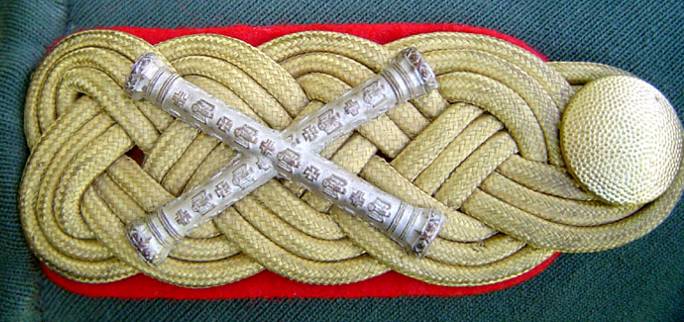
An all gold cord bullion example from GFM von
Manstein’s overcoat. Notice
the batons are the Luftwaffe pattern and are silver frosted. (private collection) |
|
|
|
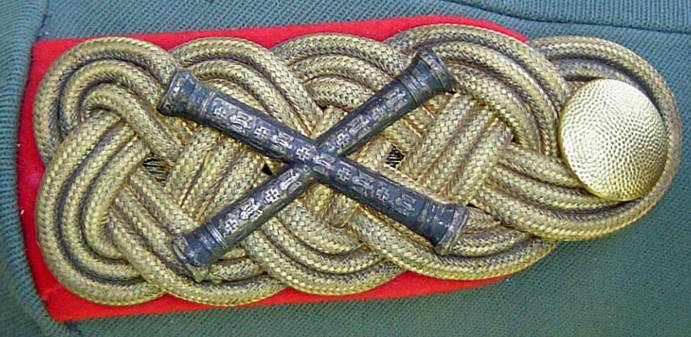
Another example of GFM von Manstein’s shoulderboard insignia from his tunic, also constructed
in three cord gold bullion but with the standard army pattern batons in dark
silver. Both tunic and overcoat
were sold and mailed directly to a collector by GFM Manstein himself. (private collection) |
|
|
|
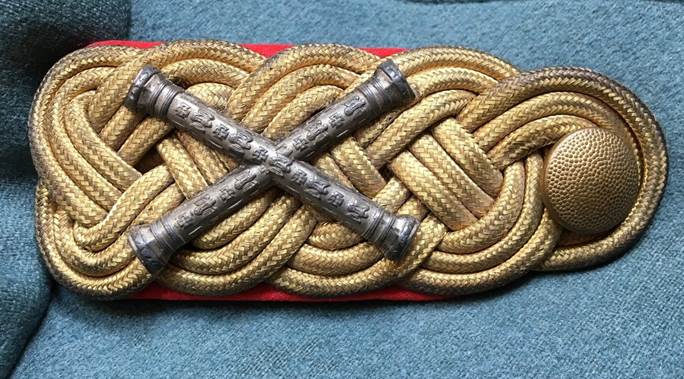
This example is
GFM Erwin Rommel’s shoulderboard insignia
from his greatcoat, constructed in three cord gold bullion the standard army
pattern batons in dark silver metal.
This coat was acquired by U.S. army personnel when they entered
Rommel’s house. (private collection) |
|
|
|
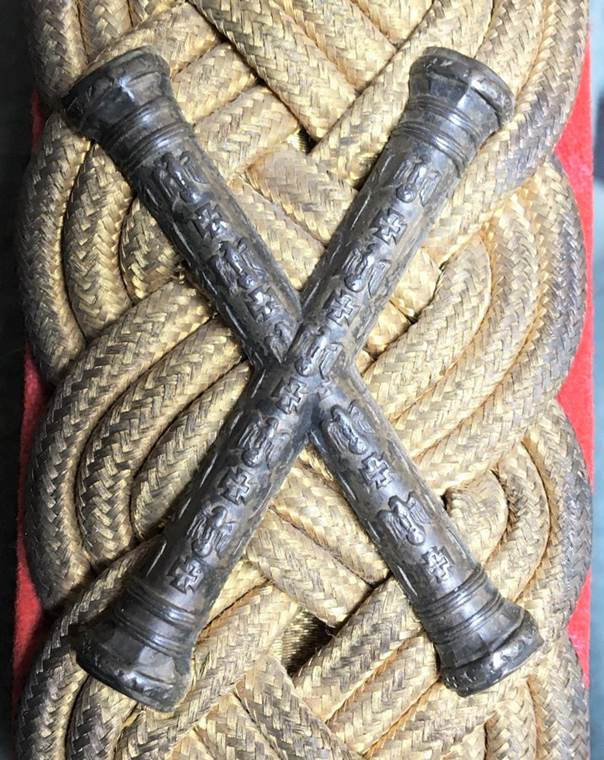
A close-up look at the features of Rommel’s shoulderboard baton devices. This is one of two die patterns, with
very distinct fingerprints that I’ve identified as having been used in
the 2nd pattern baton devices. (private collection) |
|
|
|
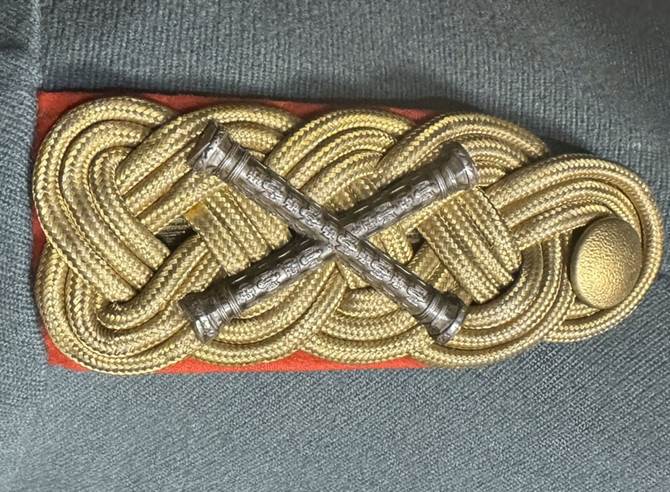
This shoulderboard is from the
uniform of Generalfeldmarschall Wilhelm Keitel,
constructed in three cord gold bullion with army pattern batons with a silver
finish. The uniform was
discovered in one of Keitel’s homes well after the war. (Sack collection) |
|
|
|
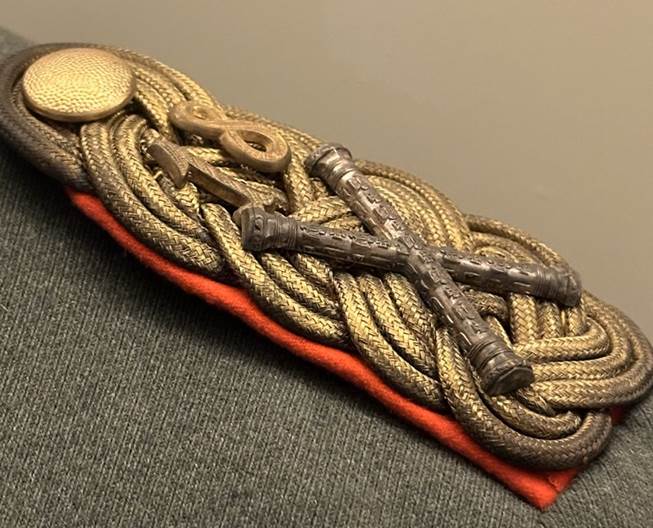
This shoulderboard is from the
uniform of Generalfeldmarschall Gerd von Rundstedt,
constructed in three cord gold bullion with army pattern batons and the
regimental numeral “18” for von Rundstedt’s position as
Honorary Colonel-in-Chief of a Regiment.
He also occasionally wore this insignia with the white underlay of
infantry as part of this honor. (Rastatt Military History Museum) |
|
|
|
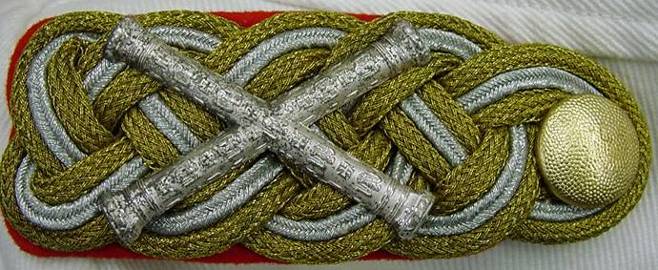
Second pattern Generalfeldmarschall
batons, with a silver frosting applied, on standard General officer slip-on
style shoulderboards (1940 style) attached to
a white summer tunic. |
|
|
|
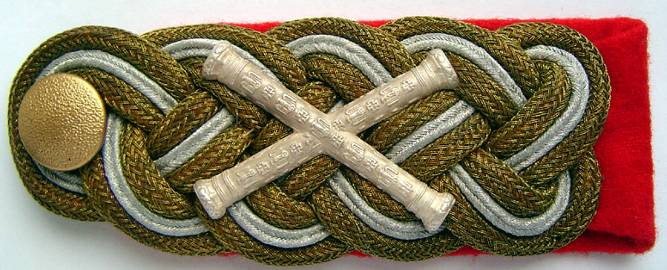
Another example of 1940 style boards with silver frosted
batons. |
|
|
|
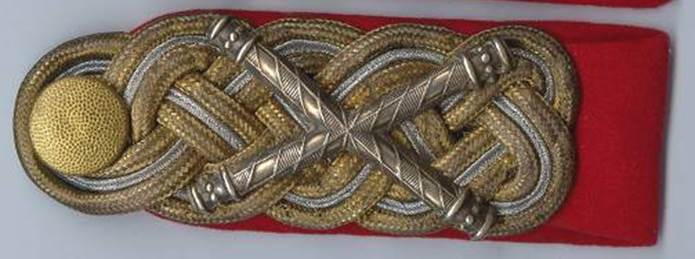
Generalfeldmarshcall Ritter von Leeb’s 1st
Pattern Generalfeldmarschall shoulderboards
in gold and silver bullion with early style, silver crossed batons. (Holzauge Historical) |
|
|
|
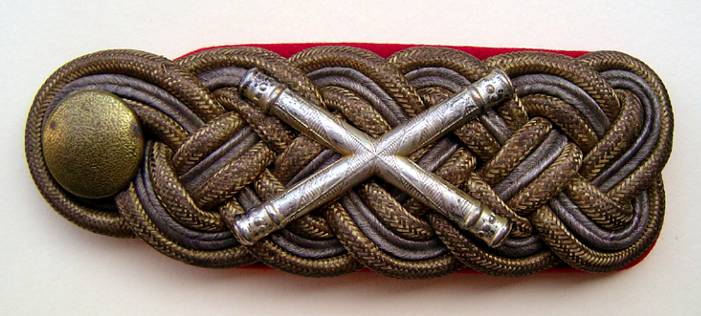
1st pattern silver Generalfeldmarschall
batons on early gold bullion and silver shoulderboards
of the rare five loop variant.
These are slip-ons and considering the size of the boards are likely
for use on the greatcoat. (private collection) |
|
|
|
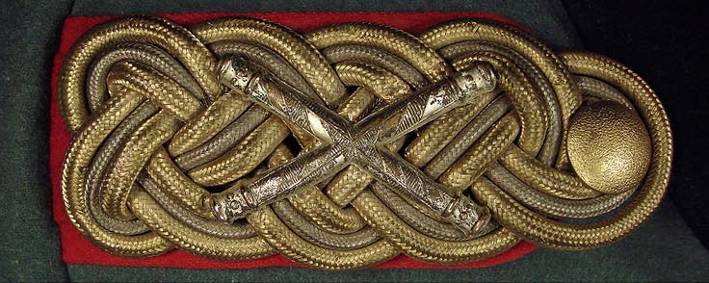
Another example of 1st pattern batons from a
greatcoat belonging to Generalfeldmarschall von
Leeb. (Peter Whamond/The Collector’s Guild) |
|
|
|
|
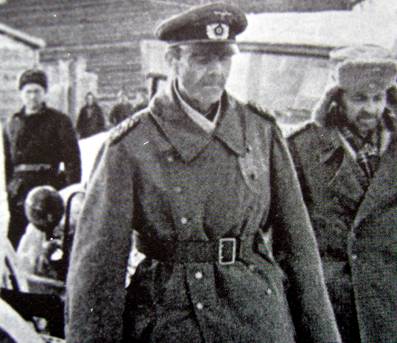
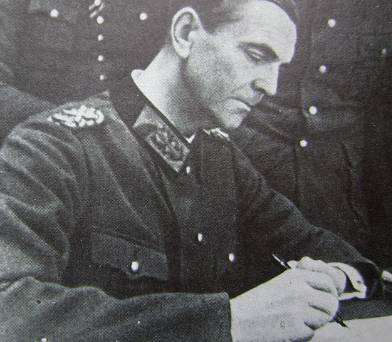
Two photographs of GFM von Paulus in captivity. The earlier picture, on the left,
shows him shortly after surrendering his army at |
|
|
|
|
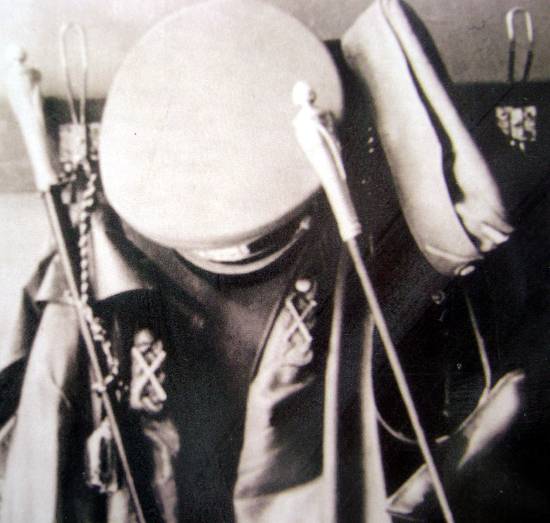
Here is another interesting photograph, for the merit of
collectors who attempt to authenticate everything according to
‘textbook’ beliefs, regulations and period of issue. These two overcoats hanging on this
coat rack belong to GFM’s Reichenau and Brauchitsch, both promoted to
GFM on the same day, July 19, 1940.
However, note that Reichenau’s coat (left) displays shoulderboards with the larger size 1936 – 1938 1st
pattern crossed batons, while Brauchitsch’s coat (right) has the
smaller, 1940 2nd pattern crossed baton devices on his shoulderboards.
One would surmise that since they were both promoted in 1940, they
should “by regulation” both be wearing the later pattern small
batons…but they are not.
You will see many mixtures of insignia that are contrary to regulation
or period of issue, when you study photographs of Generals and Field
Marshals. Note also on the right
coat, how high the small batons are positioned on the shoulderboards,
having been affixed closer to the button, rather than being centered between
the button and than the base of the board. In another glaring example of lack of
symmetry in attachment, the batons on the Reichenau shoulderboard
are also offset with the device protruding over the right side cords. |
Army
GFM Collar Tabs
|
|
|
1939 –
1940 pattern. From the 1930’s until April of 1941 Generalfeldmarschall wore the same standard pattern
collar tabs as all other General Officers, which exhibit two
‘prongs’ at the center, resembling leaves, in the middle of the
tab design and protrude above and below an oval opening. (Ron Richter collection) |
|
|
|
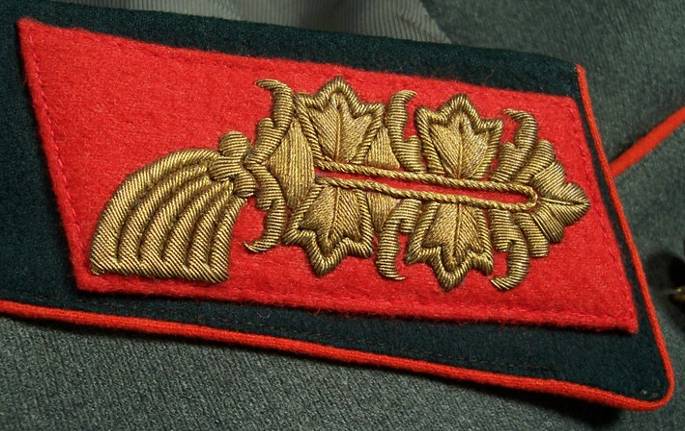
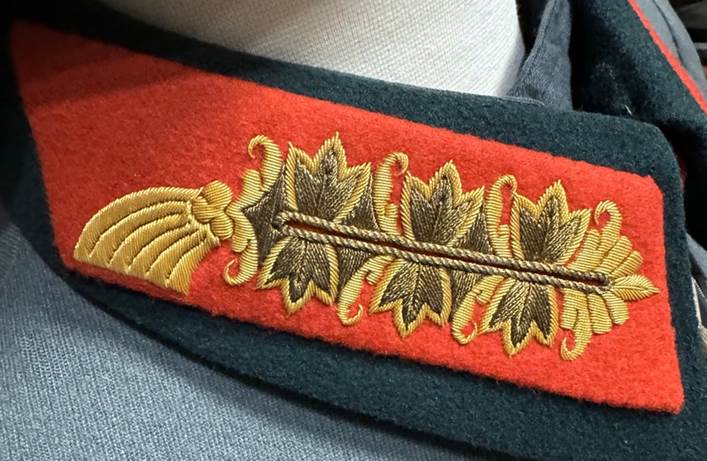
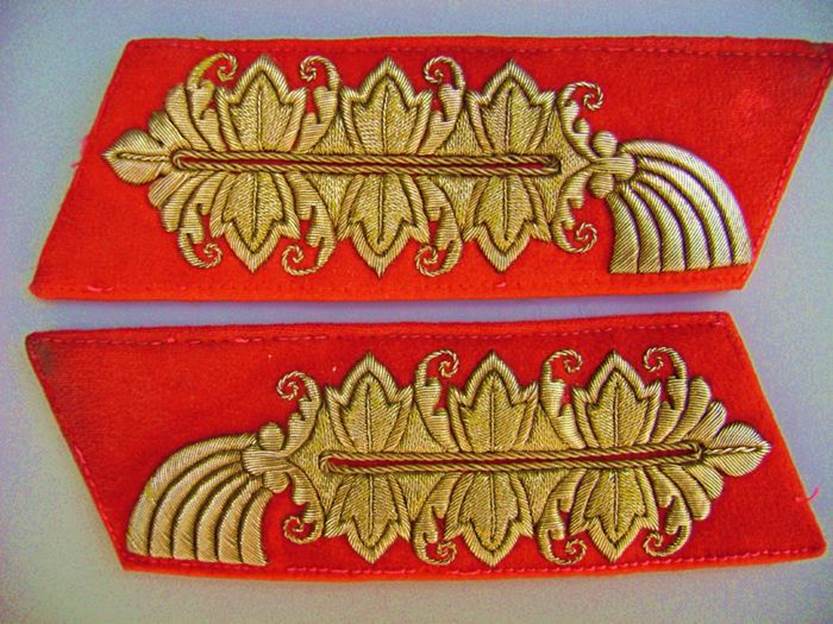
1941 pattern. In April of 1941 an order was issued to create a separate
collar tab design specifically for the rank of Generalfeldmarschall,
by adding a third “prong” or “leaf” in the middle of
the design. This made for a longer collar tab horizontally and was very
distinct from the standard General officer tabs. This example is executed in
fine gold wire and from the uniform of GFM von Manstein. This is the GFM
collar tab design most commonly seen in period photos with its very curly and
ornate curled enhancements and the odd, pointed leading edge. It’s entirely possible that one
vendor was the “preferred” supplier of these GFM tabs, which
would indicate why this particular version is the
one most often seen on period photos.
There are a few other photo verified verions,
examples of which are shown below in the “variations”. There do exist period variations of
GFM tabs that have not been photo verified, though they are thought to be
examples rendered by smaller firms to show off their craftsmanship, rather
than tabs that were actually distributed, purchased
and worn. (private collection) |
|
|
|
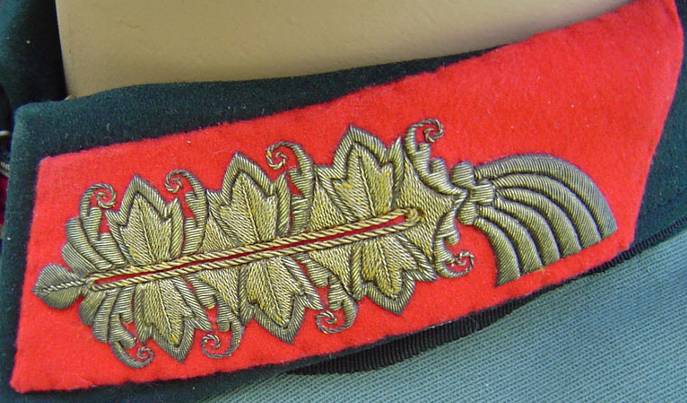
Another 1941 Generalfeldmarschall
“common” pattern collar tab embroidered in two tone gold wire,
very similar in manufacture to the von Manstein example above. (private collection) |
|
|
|
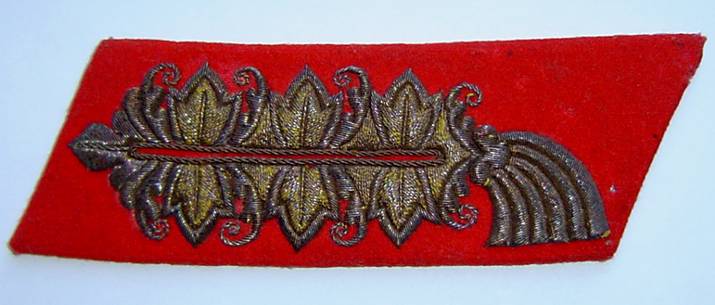
This example is
embroidered in golden-yellow celleon and from the
uniform of Generalfeldmarschall Gerd von Rundstedt. (Rastatt Museum
of Military History) |
|
|
|
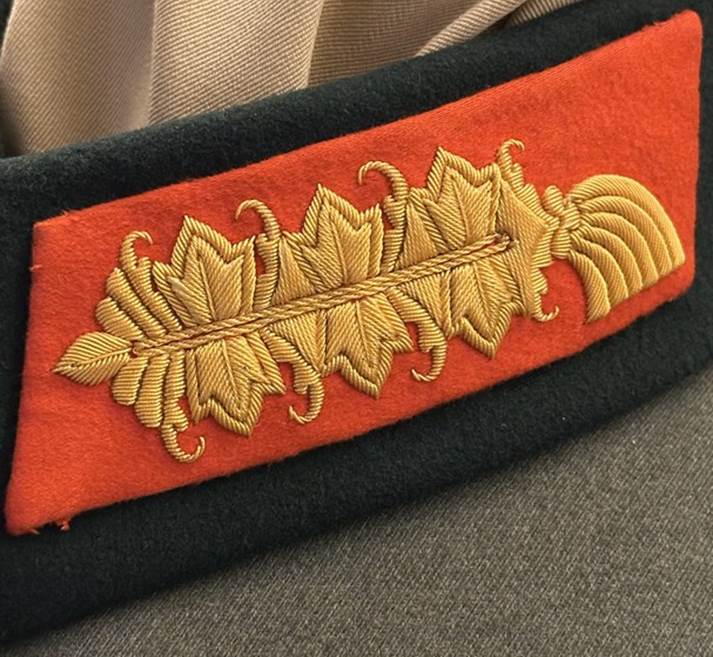
Another example embroidered in golden-yellow celleon, this one with gold wire accent threads creating
a two-tone effect. From the uniform of Generalfeldmarschall
Wilhelm Keitel. (Sack Collection) |
Generalfeldmarschall Collar Tabs
– Variations
In present day collecting, there is an over-enthusiastic
effort to try and establish a “textbook” example to every piece of
militaria. To anyone who has
collected for a length of time, it is no surprise that establishing a textbook
for militaria is often a lost cause.
Various firms were contracted to produce pieces, which in turn create
various individual characteristics as a result of the number of different
makers. It is true in badges and
awards, and it is also true in hand embroidered insignia.
In the area of GFM collar tabs, there exists a belief that
only one kind of GFM tab can be original, or as they say is
“textbook”. Usually
beliefs like this result from the fact that one particular maker produced the
vast majority of items…in other words, they got the biggest contract to
produce the largest volume. This is
where period photos become so important in collecting, as evidence shows there
could be many variations, some even rather radical in design. The same can be said of GFM collar tabs,
as there is evidence that there may have been as many as 3 or 4 different
makers, though one features predominately in all the period photos.
Keep in mind that there were only 19 Heer Field
Marshal’s, so there was certainly no reason to mass produce this particular insignia.
However, there may have been embroidery firms that wanted to create
their own examples of this rank to display as samples of their embroidery
quality. When attempting to collect
this rank, one must exercise extreme caution, as the difference in value
between a photo verified and “accepted” GFM tab and the those that
are not verified and may have been created as display samples is quite
vast. Not to mention that many will
just consider them fake (and some may be!).
|
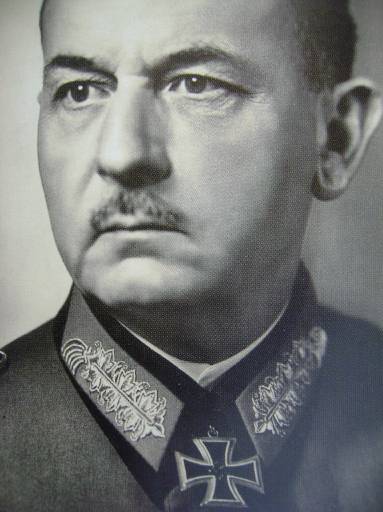
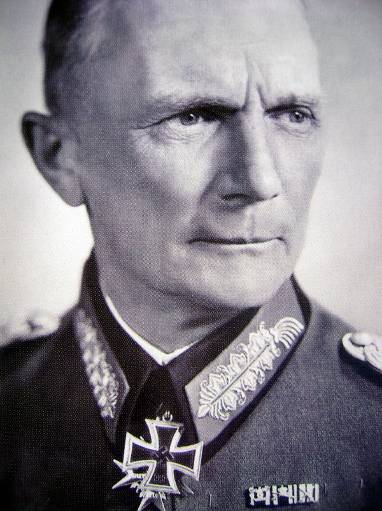
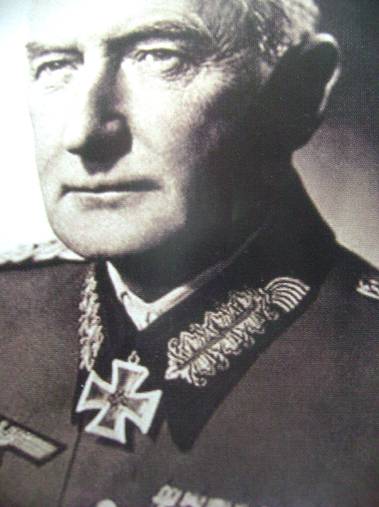
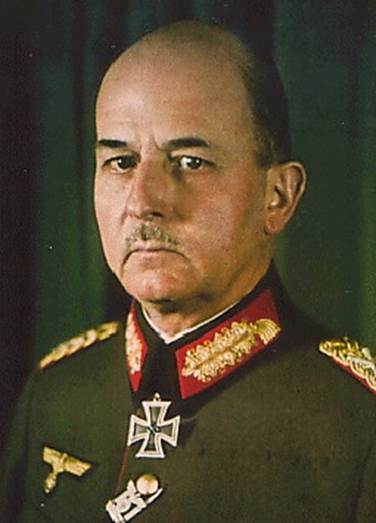
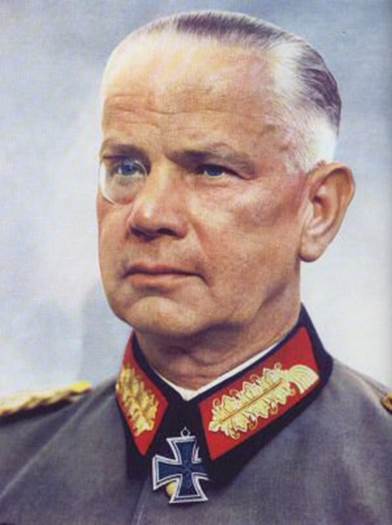
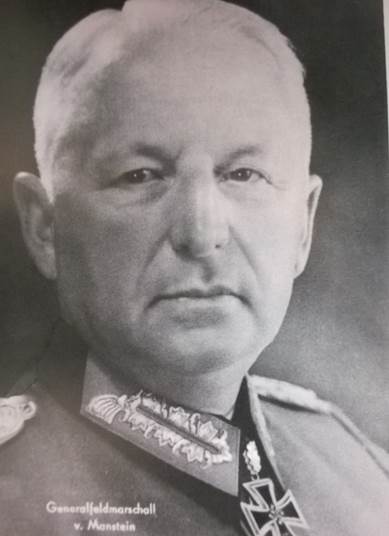
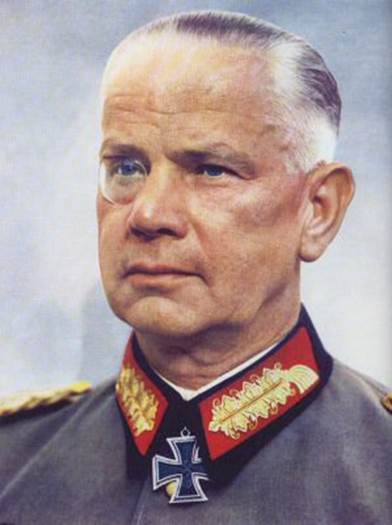
In the photos below of GFM List (left) and Bock (right),
we see what is commonly viewed as a “textbook” GFM tab. It is very ornate with a lot of very
tiny, accentuated curls from the stems, or prongs that protrude upward. This is the tab you will most commonly
see in many of the official portraits when the GFM’s are wearing their
best uniforms. As a result, these
could possibly be considered their “dress” versions of insignia,
as we do know that there existed higher quality, bright insignia for parade
and formal dress. |
|
|
|
|
|
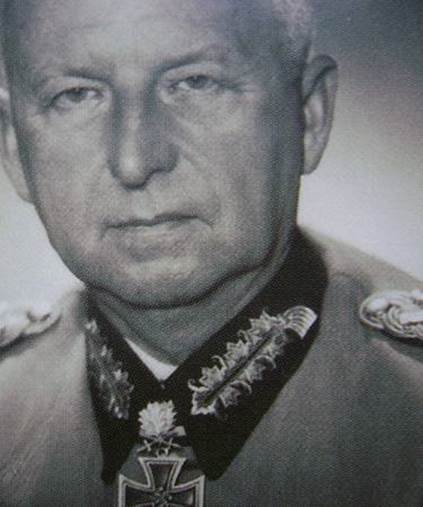
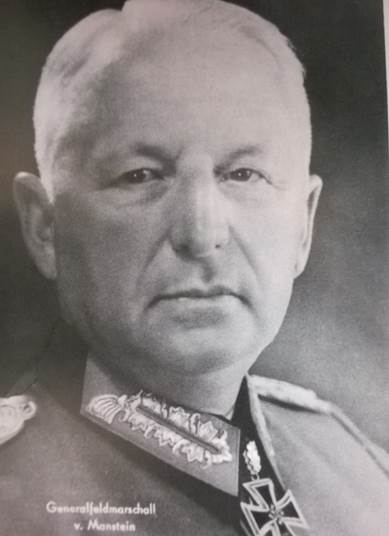
Another example of variation on GFM tabs being worn by GFM
Manstein (left). Notice how
crowded the embroidery is on GFM Witzleben’s tab in the right
photograph, in comparison to the Manstein tabs in the left photograph. We know from evidence in period photos
as well as one of his surviving uniforms that Manstein also wore the very
curly, more ornate tabs such as in the Witzleben example. Photos also exist showing Manstein
wearing in the field what appear to be celleon
examples. Also notice how the
center oval on Witzlebens tab is closed, unlike the
more “textbook” examples shown above being worn by List and Bock,
which have open ovals. It is good
to keep in mind that even in Generalfeldmarschall
insignia, there is quite a bit of variation. |
|
|
|
|
Exploring
Examples of the Three Photo Verified Variations
Field Marshal Tab
Version “A”
|
|
|
|
Unlike standard Generals tabs, Field Marshal tabs are known to be much more consistent in their design and execution, leading many collectors to mistakenly thinking there is only one “accepted” design. Since there were so few Field Marshals in comparison to Generals, it’s logical that a much smaller quantity of this insignia, and as a result fewer variations, were produced. Most likely one firm, perhaps in Berlin, produced the bulk of these particular examples. Above are pictures of Field Marshals wearing what is considered the typical, most commonly encountered tabs for this rank. I will refer to this style as Version A. The quickest method to identify these tabs are firstly by the very pointy protrusion on the nose of the tab, which resembles a spade, and secondly by the very curly, ornate horns that frame and curl around the three inner prongs. |
|

|
|
|
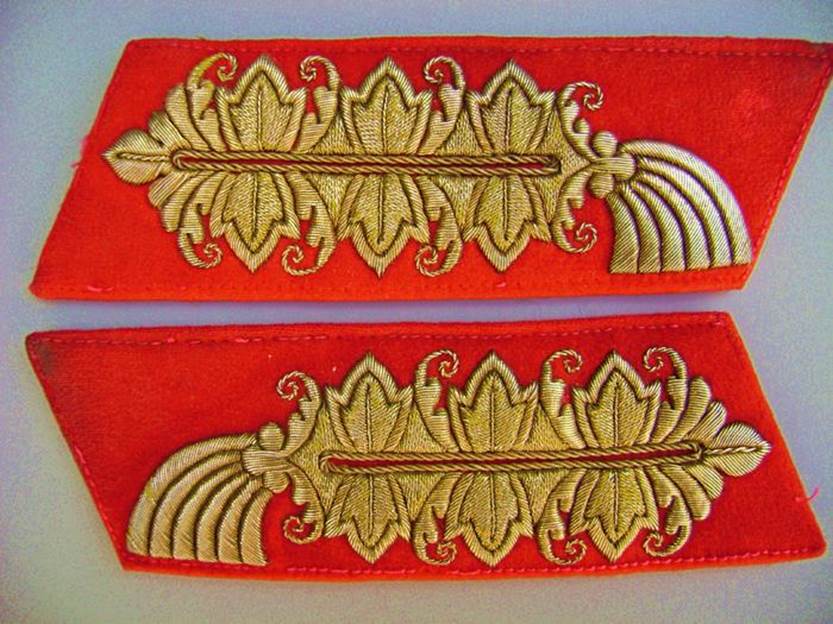
These collar tabs are attributed to Field Marshal Keitel
and are perfect examples of “Version
A”, the most commonly encountered collar insignia for this rank,
with the spade-like front nose and extremely curly and ornate horns framing
the three prongs. |
Field Marshal Tab Version “B”
|
|
|
|
|
This is a variant Field Marshal tab, worn here by von Manstein, (who also wore the more commonly encountered tab). I will refer to this style as Version B. Notice how the nose of the tab doesn’t have the spade and the nose is more compressed. The horns, while still rather curly aren’t quite as exaggerated as the Version A examples. The third variation to this B style tab is the backbone does not have the three well-formed and pronounced balls and instead is somewhat bird shaped. |
||
|
|
|
|
|
Here’s a nice example of the Version B variant tabs
showing the distinct differences described above. |
|
|

|
|
|
Note this interesting feature on this “B”
version; the inside “brush” on the tail, right where it connects
to the bird shaped tailbone (sometimes they are more ball shaped). Notice how it extends below, which is
much different than most General (and Field Marshal) tabs in this area. |
Field Marshal Tab Version “C”
– The Rommel Variant
|
|
|
These tabs that Field Marshal Erwin Rommel is wearing are
distinctly different than the other tabs explored above, and is the third
variation we’re looking at, which I call Version C. Notice how
short and stubby the nose of the tab is and how it almost looks like a
flower. Now look at the tail and
notice how pronounced and thin the brush is and how the underlay shows
between the embroidery on the brush tail. Also take note of the tailbone and
how it also resembles a flower, rather than the “balls” or
“bird-like” pattern of the versions A and B. |
|
|
|
Here are the exact same tabs, which are displayed in the
Imperial War Museum in London.
They were given as a gift to British Field Marshal Bernard Montgomery,
along with one of Rommel’s shoulderboards.
Again, notice how unusual and thin the design is, which would’ve
required a different unterlagen (cardboard
template) than what other GFM tab variants used. As rare as this rank was, there were
obviously more than one manufacturer. |
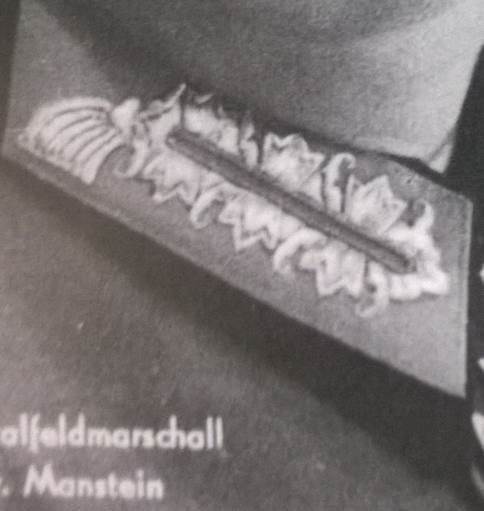
There are a
few other variations of Field Marshal tabs that I’ve encountered, most of
which I suspect are manufacturers samples that were either produced in hopes of
obtaining a contract or were never sold or distributed and perhaps just used
for display. Until they can be identified in a period photo, they will remain
as examples that were apparently period produced, but never utilized. In the future I will be expanding this
section on a regular basis to add any new information that is discovered.
Multiple
Variations in Wear by Generalfeldmarschall Kleist and
Another Variant
|
|
|
|
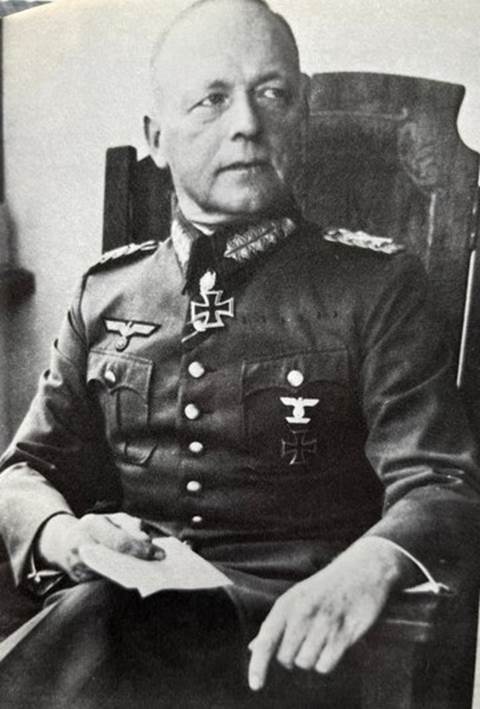
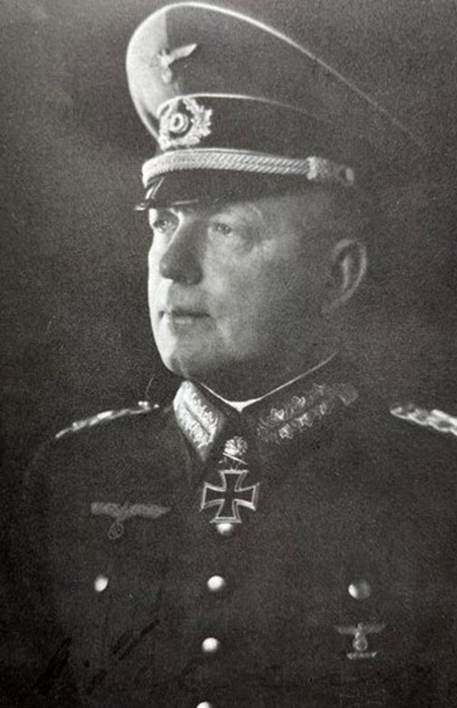
Here we see two period studio portraits of Kleist wearing the A Version of the Generalfeldmarschall collar tabs on the left, and a completely different unknown version of the tabs on the right. It does not appear to be a B type, nor the Rommel version, though the nose/leading edge does look very similar to the Rommel variant. They are clearly different uniforms, with the 8-button early style tunic on the left and a 6-button tunic on the right. |
|
|
|
|
|
Close up images of the two above portraits. You can see that the very ornate
curling of the “horns” on the embroidery (which is the hallmark
of the more predominately worn Version A tabs) on the left photo (notice also
the difference in the nose or leading edge
embroidery). The photo on the
right shows a pair of tabs devoid of the ornate curls and
also a very odd and different looking nose/leading edge, very similar
to the Rommel version. However,
they do not match the Rommel version, as the horns around the inner prong
face in different directions and don’t have the pronounced curl. This is the only photographic evidence
I’ve found of this variant. It is possible the tabs on the right are
from the same embroidery firm that produced the Rommel variant, and perhaps a
different embroiderer in the firm produced these, creating a slight
variation. |
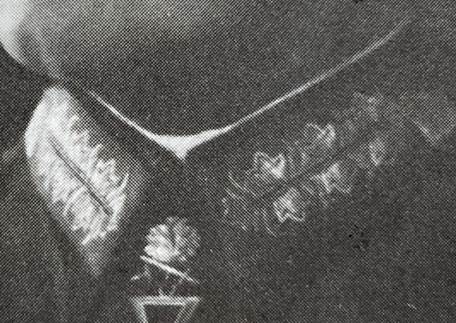
|
|
|
|
|
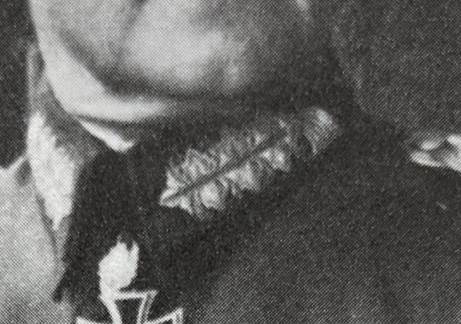
In this photo we find GFM von Kleist wearing the more commonly encountered Version A tabs with the more ornately embroidered “horns” featuring the severe curled ends and pointed nose at the leading edge. Notice that these A tabs have a more pronounced nose than the A tabs in the comparison table above with Kleist in two different uniforms. One has to keep in mind that embroidery was done by hand, and multiple embroiderers were often involved. A different set of hands will add slightly different characteristics to the same template. It is quite interesting how one Field Marshal can have three different uniforms, each with distinct differences in the collar tabs. I think this also puts the old belief that there was only one style of these collar tabs firmly to rest |
|

Other Possible
Variations
|
|
|
|
Here’s a nice example of a mint condition pair of
tabs embroidered in celleon by the firm of Thiele
& Steinert of Berlin. These are
House Master samples to be used as a guide when embroidering the
insignia. It’s not known if
they were actually used as a period photo showing
this manufacturer’s example in wear has yet to surface. They seem to replicate the A style, with the exception of the tail which is more similar to the B style. A large variety of mint Thiele
& Steinert insignia emerged into the collector market in the early
2000’s and much of it can still be found for sale. (private collection) |
|
|
|
|
|
A close-up examination of the Thiele & Steinert Generalfeldmarschall collar tab. (private collection) |
|


|
|
|
Another celleon embroidered Generalfeldmarschall tab, similar to the Thiele &
Steinert tabs but with gold wire accent threads. |

Comparing an Original
to a Reproduction
|
|
|
Like any other rank, Generalfeldmarschall
collar tabs are reproduced, though quite frankly they are never done to the
degree of quality of the originals.
Here is a good example of a commonly encountered reproduction at the
bottom of the photo, with an original above it (the original being obvious in
superiority of embroidery and it also displays a significant amount of
age-darkening to the gilt metallic wire thread). Study this carefully and it will
immediately become apparent that there is quite a difference in the quality
of embroidery on original pieces in comparison to the fakes. One must keep in mind that the
artisans who embroidered insignia in Germany before and during WWII did this
as a profession on a daily basis for decades and as
a result were quite skilled. They
also had quality standards to follow which led to a great deal of
consistency. In contrast, most of
the modern-made reproductions are produced in countries such as
Pakistan. They are made as
quickly as possible with little regard to quality as they are produced and
sold at a very low price. As a result, the lower quality of embroidery and
materials is quite noticeable compared to originals. |
Army GFM Sleeve Grade Insignia
|
|
|
Generalfeldmarschall
sleeve rank insignia for use on all uniform garments without shoulderboards, effective August 1942. (Pieter Verbruggen collection) |

An Exploration of
Heer Generalfeldmarschall Erwin Rommel’s Insignia;
An article I authored on Field Marshal
Rommel’s insignia is now published and available for purchase. Below is an announcement I made in 2025
including photos of a few pages from the magazine and a link to purchase a copy
of this issue of International Militaria Collector from B & D
Publishing.
In early January of
2025, myself and David Bunch (collector/author/historian on the Afrikakorps and Rommel) had the honor and pleasure to be
invited to meet with the family of Generallfeldmarshcall Erwin Rommel in Stuttgart,
Germany. We were asked to help them
identify, document and photograph a large group of his surviving insignia and
personal effects that were recently discovered by the family.
This discovery
included a large variety of his General rank and Generalfeldmarschall
insignia, a greatcoat, a visor cap and many other very interesting
surprises! As a result, David and I
authored a couple of articles on this material that is now published in
Dietrich Maerz’s International
Militaria Collector magazine. Within these
articles we explore these amazing finds in depth and have included photographs
and detailed descriptions of each piece.
We made some very interesting and revealing discoveries that will
provide new insight to both insignia and senior ranks collectors as well as
“Desert Fox” historical aficionados.
Eventually I hope to
also include a few of these discoveries on this website, but if you want an
all-inclusive, in-depth look at the treasure-trove of newly discovered Rommel
artifacts you will have to acquire a copy of the magazine, which is now available
(as of July 11, 2025). Between the
two articles there are 36 pages of detailed coverage of artifacts which have
never been seen before.
For shipment within
the USA: International Militaria Collector Vol.13/2 - B&D Publishing
LLC
For shipment
Internationally: International Militaria Collector Vol.13/2 Special Issue -
B&D Publishing LLC
|
|
|
|
|
|


The Generalfeldmarschall’s Dagger
|
|
|
A copy of the 1941 Model Field Marshal’s Dagger.
About six such original examples were produced, but general production of
these was shelved due to the war.
This is one of only a half dozen replicas that were produced from the
original specifications and images. (private collection, photography by F.J. Stephens) |
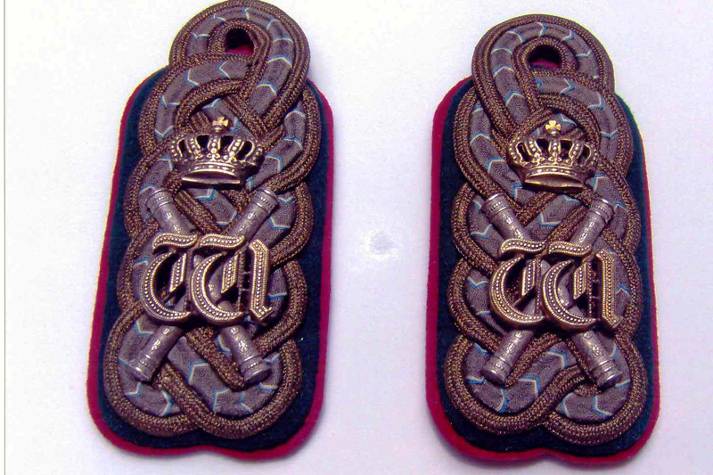
Pre-WW2
Generalfeldmarschall Insignia
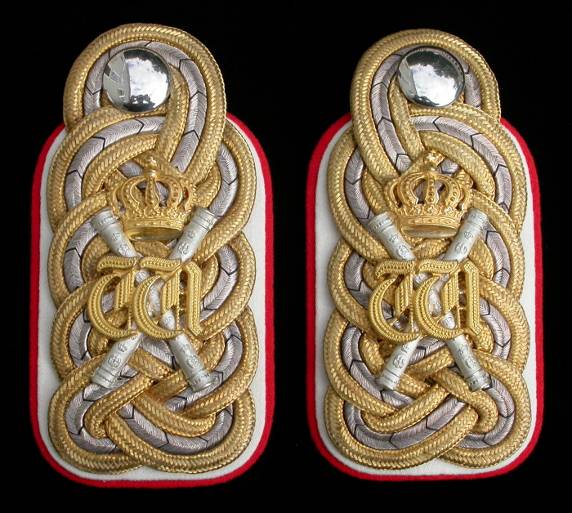
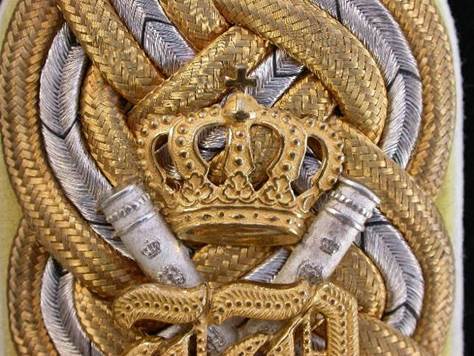
Kaiser Wilhelm II’s Generalfeldmarschall Shoulderboards
These
shoulder boards belonged to Kaiser Wilhelm II and indicate the rank of Generalfeldmarschall and honorary chief of the Garde Uhlan
Regiment (Boward Collection)
|
|
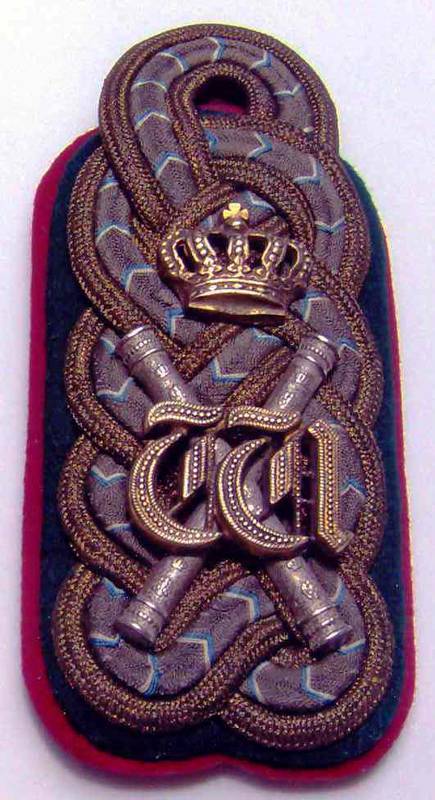
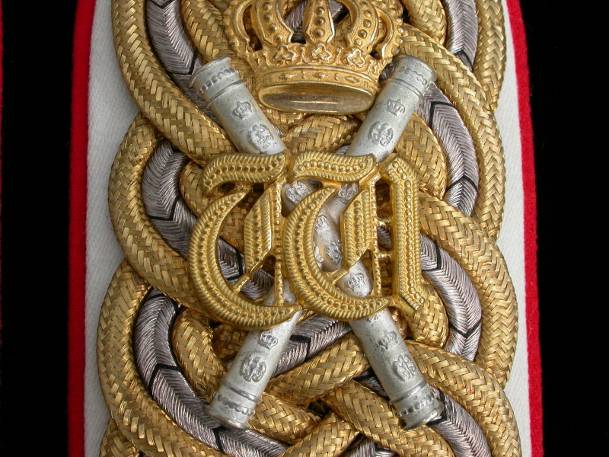
Kaiser Wilhelm II’s Generalfeldmarschall Shoulderboards
These
shoulder boards belonged to Kaiser Wilhelm II and indicate the rank of Generalfeldmarschall as honorary chief of a Jaeger
Regiment. (Boward Collection)
|
|
Kaiser Wilhelm II’s Generalfeldmarschall Shoulderboards
These
shoulder boards belonged to Kaiser Wilhelm II and indicate the rank of Generalfeldmarschall and Chief of the Cuirassier Regiment
“Von Seidlitz”. (Boward
Collection)
|
|
|
|
|
|
|
|
|
|



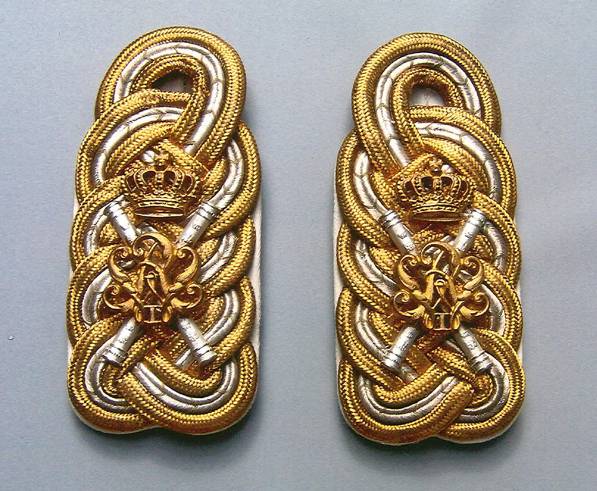
King Friedrich August III Generalfeldmarschall Shoulderboards
This pair
of General Field Marshall boards were the personal property of King Friedrich
August III (1865-1932) of
|
|

Grand Duke Friedrich II of
This pair
of Generaloberst in the rank of Generalfeldmarschall
boards were the personal property of Grand Duke Friedrich (1857-1928) of the
Grand Duchy Baden, a grandson of Kaiser Wilhelm I. These very rare boards were worn by the
Grand Duke (r.1907-1918) while serving as the regimental chief of 8. Wurttembergisches
Infanterie-Regiment “Grossherzog
Friedrich von Baden” Nr. 126.
The regiment was founded in 1817 and garrisoned at Strassburg. In 1875 Friedrich was promoted to Leutant in the most elite Erstes Garde-Regiment zu Fuss (1st Guard
Foot Regiment). He was promoted
Generaloberst in the rank of GFM in 1905. The boards have the red chevrons of Wurttemburg, the three pips of a Generaloberst,
the crossed batons of a Generalfeldmarschall and the
regimental number. (Mike Kelso collection,
|
|

Kaiser Wilhelm II’s Generalfeldmarschall Shoulderboards
These
shoulder boards belonged to Kaiser Wilhelm II. They are for Royal Saxon 2nd
Grenadier Regiment number 101 “Kaiser Wilhelm King of Prussia”,
garrisoned in
|
|
|
|


Kaiser Wilhelm II’s Generalfeldmarschall Shoulderboards
These
large boards belonged to Kaiser Wilhelm II as Chief of the King’s 1st
Bavarian Uhlan Regiment 1915 in the rank of Generalfeldmarschall. They are the ultra-rare feldgrau pattern
displaying crossed batons, royal cipher and Imperial crown. (Courtesy the Scott
McCaleb collection,
|
|
|
|


Generalfeldmarschall Friedrich
Franz II, Grand Duke of Mecklenburg-Schwerin Shoulderboards
These boards are from the 1800’s and are courtesy the Thomas Suter collection.
|
|
|
|
|
|


|
|
|
|
|
|


|
|
|
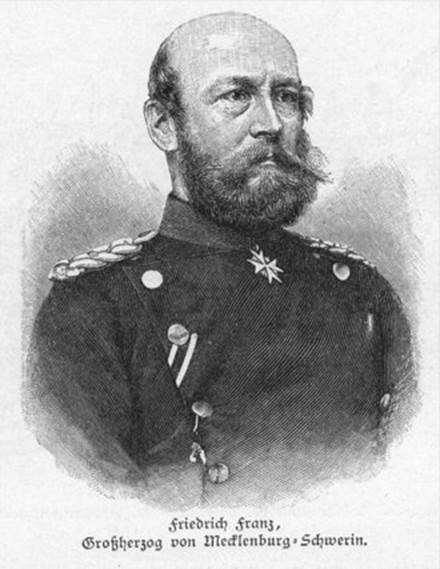
Generalfeldmarschall
Friedrich Franz II, Grand Duke of Mecklenburg-Schwerin |
![pers_friedrich_franz2_mecklenb_1823[1]](GFM%20and%20High%20Ranks_files/image137.jpg)
For a study of Luftwaffe Generalfeldmarschall items, go to the Luft GFM page here;
Luftwaffe Generalfeldmarschall
